EVENT - The discussion will continue for the time being, inkjet has seen considerable developments in the last two years, the share of digital productions is still relatively low, however. But the financial value of the digital market share is increasing rapidly. What did the experts say at the table during Sign&Print Expo 2022 in The Netherlands?
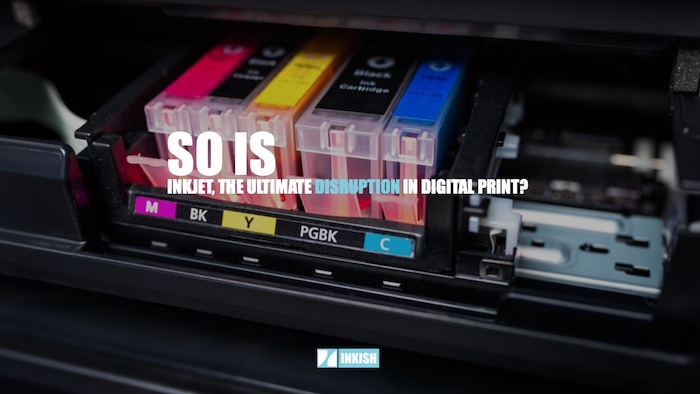
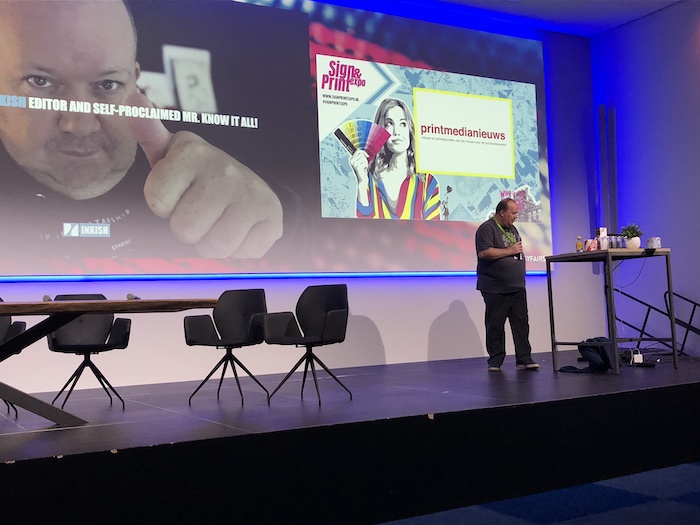
Morten Reitoft of INKISH kicked off the first day of Sign&Print Expo 2022 with his keynote. He asked himself the question whether inkjet will be the ultimate disruption in the digital print market(s) in the short term.
He came to the conclusion that this will not be the case (yet). At the same time, he stated that inkjet could already offer the most business opportunities in 2022, if there are sufficient insights into how companies can respond to market demand.

At the table were Eelco Hoogendoorn (HP), Rob Boumans (Crown Van Gelder), Ewout Maartense (Landa), Rob van Wanrooy (manroland sheetfed) and Frank Huigen (Canon) (see header photo). During the introduction round, everybody agreed with Reitoft's conclusion that inkjet is not ready yet (by far). There is a lot to do in the combination of inks, substrates and drying. In addition, of course, attention must be paid to workflow automation, but the latter also applies to offset and toner, of course.
It became clear during the round table discussion that it is not always about growth in numbers of prints, speed or capacity. The match of whether or not to combine offset, inkjet and toner has much more to do with the whole range of activities within a company. From that great diversity, it is therefore not possible to determine an unequivocal average. Hoogendoorn: "So it's not always about growth. Ewout Maartense supplemented with the statement that inkjet is currently not at all the basis for the disappearance of offset in the short term.
Boumans: "By now, it has become clear that paper plays a crucial role, not only for inkjet, but also for offset and toner. That aspect is currently mainly driven by the current uncertain economic climate."
Maartense: "Offset still most cost-effective with large print runs, toner purely for niches, small-scale applications, where pure speed plays a much smaller role than with inkjet."
Rob van Wanrooy, as a broad provider of 'analogue' and digital systems, emphasised that the 'spot on' applications, as Reitoft called them in his keynote, is the most important starting point for making the right choices. "The customer's applications define the playing field between hardware, software and all possible consumables.
In addition to the developments in technology in recent years, we can expect much more from inkjet in the coming years. However, the state of technology today has already ensured that inkjet is a dominant technology which has been fully embraced by the printing industry. "There is still room for improvement in the relationship between variables (ink, paper, technology), but we can say that in terms of output quality we have made huge steps, that discussion is really over."
Huigen said that developments are currently influenced mainly by macro-economic parameters and not least by the current turmoil in the world. "The role of paper as an information carrier will again be scrutinised, compared to other media channels, so there are plenty of opportunities."
Despite the fact that there is a lot of talk about digital, the market share is still relatively small and growing relatively slowly. Inkjet is gaining ground, especially by being able to quickly change jobs of small size. More important is the financial value of that still small volume share. The financial value is rising sharply. Maartense: The 5-6% market share in digital represents 20% in monetary terms of the total print market."
Wanrooy argues that the current shifts in the market are not as big as expected: "Don't confuse the focus on inkjet with the role distribution of different applications over the 'other' printing and print techniques."
The panel was wholeheartedly convinced that companies - large and small - in this day and age are well aware of what technology has to offer. Of course, investment processes take a long time, but companies take their time and know what they want. Also in terms of sums. The spreadsheets used to calculate all the techniques, costs and yields are certainly a good tool.
Hoogendoorn: "The condition to be able to keep up is especially in the full management and control of the workflows, but then up to and including finishing."
Hoogendoorn said that mutual trust also plays a substantial role. "If you enter into a relationship with each other on the buy and sell side, that requires a lot of mutual trust for a very long period of time."
Huigen: "At Canon, we have a broad portfolio and in all market segments we generally experience quite a bit of upfront expertise. people know where they want to go."
Maartense added that within Landa's playing field, a certain volume is a requirement for joining Landa: "With our technology, we are really at the top end of the market; with 100,000 prints per month, Landa is not an option." He was referring to the recent figures achieved by Simian on the S10P.
Boumans is regularly approached for advice regarding the investment in inkjet. Crown Van Gelder paper mill is specialised in paper for inkjet processes and therefore tests their paper against the various solutions on the market. Boumans: "We have an independent role, drawing the attention of the searching customer to the right combination of colour profiles, inks, paper and drying. In addition to the purchase of the machine, we mainly emphasise the enormous potential that the variable costs can create, either per job or in the overall financial picture."
A few years ago, this was only reluctantly admitted, but nowadays it is no longer a secret. For example, significant investments are needed to develop inkjet heads, and these are therefore also exchanged and applied between them.
Platforms are becoming increasingly important to extend the life cycle of solutions. Inkjet requires substantial investments, which makes a longer life necessary, as all providers realise. The time is past - as it was for the first generations of toner - when a machine was taken out of the range and companies 'just' had to invest in a new one. However, it was stated that upgrades do not always have to consist of hardware, with 'tuning' adjustments, for example, a lot can be done to be able to use several substrates in a suitable manner.
The developments in the paper market and the related aspects of sustainability are, of course, topical. Boumans responded: "We keep our portfolio as focused as possible, but of course we see enormous shifts in the supply, many mills change their supply from graphic paper to other applications. There is indeed a lot going on, and that means that the sector as a whole can also reorient on sustainability aspects in the choice of paper and therefore also in recycling. Frank Huigen stated that there are few standards and that the demand for 'everything on everything' could be more focused, thus also contributing to increasing the sustainability of paper use.
In contrast to the second panel session on Wednesday, this issue still resulted in the conclusion that there are a lot of parameters that everyone can adjust in order to make their own choices. Reitoft was also cautious in his keynote and used 'maybe the best' as a precursor to the choice for inkjet. We will talk more next year at Sign&Print Expo 2023.




Login
New User? Signup
Reset Password
Signup
Existing User? Login here
Login here
Reset Password
Please enter your registered email address. You will recieve a link to reset your password via email.
New User? Signup
Currency Exchange Graph