The End of the Room: How Capsule Living Redefines Presence
Less Space, More World: The Architecture of Modern Mobility
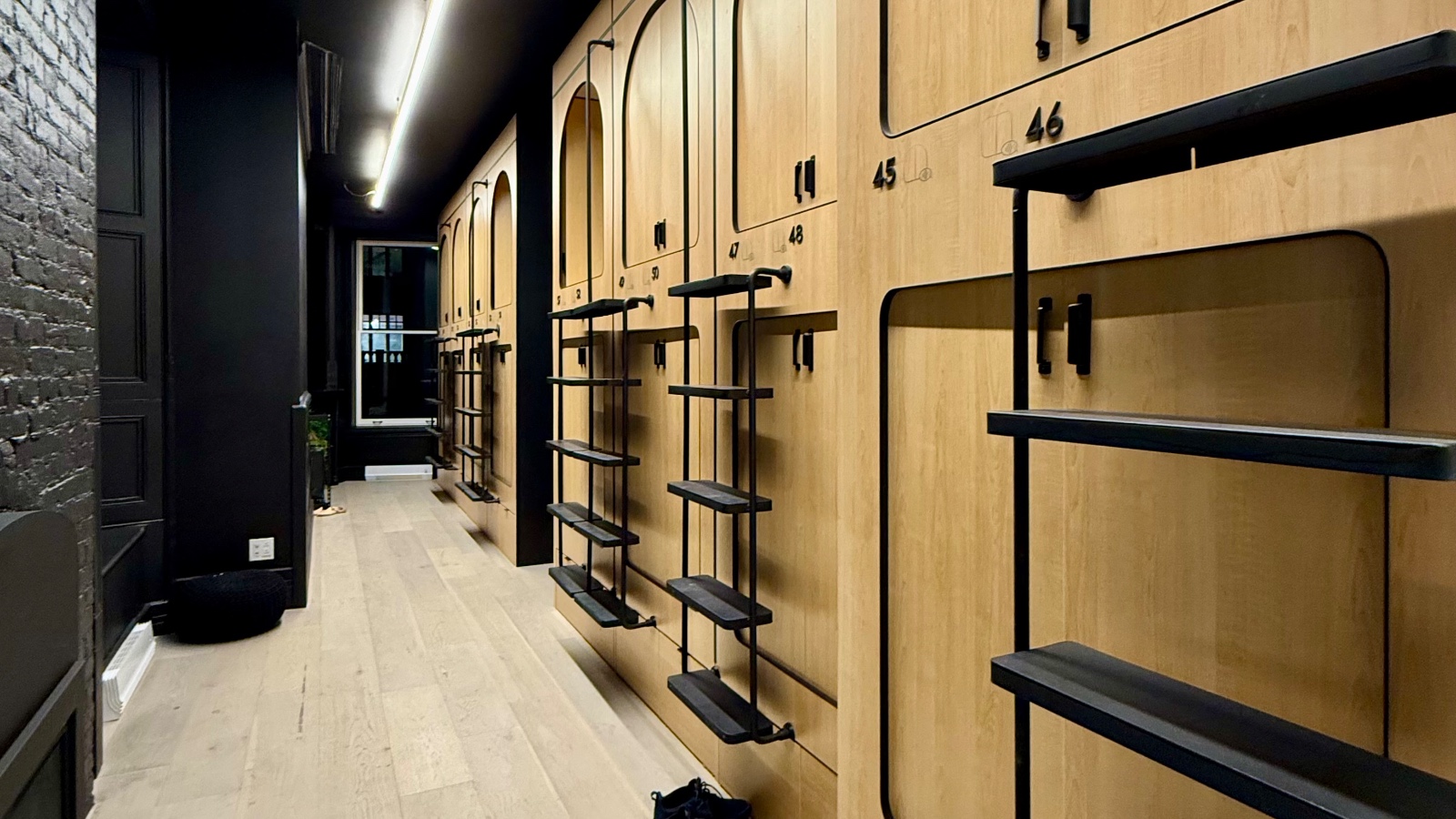
You arrive late. A small bag, no more than what fits above a seat. The city is still awake. The capsule is already waiting—quiet, precise, sufficient.
There is no sense of reduction. Only clarity.
From Constraint to Choice
When Kisho Kurokawa first imagined the capsule, it was not an invitation to a new lifestyle. It was a response to pressure. Space was scarce, cities were tightening, and architecture had to adapt. The Nakagin Capsule Tower asserted that living could be reduced to its essential form, without losing dignity.
What has changed is not the capsule, but the world around it.
For a long time, the idea remained there—contained within its origin, admired but distant. It did not travel easily across cultures because it was born of necessity, not desire.
There is a quiet philosophical continuity between Kurokawa’s work and that of Dieter Rams—despite the distance between architecture and industrial design.
Both pursued reduction, not as an aesthetic gesture, but as a discipline. Rams stripped products to their essential function, guided by clarity and restraint. Kurokawa applied a parallel logic at the city scale.
Living spaces reduced to their purpose, yet designed to adapt and endure.
What they designed across different disciplines now converges in how people choose to live.
Modularity becomes the bridge—independent units in a larger system. Structure exists without excess. Even visually, the clarity and neutrality of this thinking echo the modernist discipline of Helvetica—a language where nothing unnecessary remains.
Travel is no longer episodic; it is continuous, woven into the rhythm of professional and personal life.
There was a time when travel marked a departure. It required preparation, disruption, and return. Now it blends.
In this rhythm, space itself begins to change meaning.
Movement is frequent, sometimes spontaneous. Possessions are reduced to what is essential. The distinction between being “away” and being “in life” has softened, almost to the point of disappearance.
The Economics of Lightness
Long before arrival, the shift begins elsewhere—quietly, at the airport. Air travel has recalibrated its logic. What you carry is measured, priced, and subtly discouraged. Larger luggage is no longer neutral; it is penalized. The message is clear: move lightly. And so you do.
What begins as policy becomes behaviour. What begins as constraint becomes discipline. By the time you arrive, minimalism is no longer an idea—it is already practiced.
The capsule does not impose this logic. It aligns with it. Aviation shapes how we move. Capsule living shapes how we pause. Together, they form a continuous system—mobility without friction.
Solitude Without Isolation
It is easy to interpret this reduction as withdrawal. But the experience suggests something more precise.
This is not isolation. It is a selective presence.
Inside the capsule, there is quiet—not emptiness, but containment. Outside, the city remains open, immediate, and accessible. You move between these states effortlessly, choosing when to engage and when to step back.
The City as the True Living Space
In cities like Montreal, this model naturally fits. A city rich in culture, walkability, and seasonal changes becomes more than just a destination; it evolves into a vibrant living space.
Even proximity takes on new meaning. Being within walking distance of familiar anchors—such as the Apple Store—is less about convenience than about familiarity. It is about integrating into the city's rhythm. The same quiet advantage extends outward: to the Montreal Museum of Fine Arts, the campuses of Concordia University and McGill University, the expanse of Mount Royal, and the large indoor malls that sustain continuity through every season.
The capsule, then, is not a final destination. It serves as a point of access.
The capsule allows the traveller to exist at the thing, without permanence or fanfare. They move lightly between culture, commerce, and landscape. The capsule satisfies a quiet, persistent curiosity without demanding accumulation.
What appears to be a hospitality concept turns out to be something more coherent.
Kurokawa’s Metabolist vision and Rams’ design philosophy converge in a shared rejection of excess—one through adaptable architecture, the other through enduring objects. Today, that logic extends into behaviour.
Across systems—aviation, accommodation, digital environments—a consistent pattern emerges: reduce friction, reduce excess, increase clarity.
Minimalism is no longer just about aesthetics; it has become functional.
If millennials normalized this shift toward lighter, more fluid living, the generation that follows has never known any other way. For them, mobility is not a decision but a condition. They do not arrive at minimalism. They begin with it. In their hands, the capsule is no longer an innovation, but a natural extension of how space, movement, and experience converge.
The room is not literally disappearing. But its role is.
No longer the center of travel, it becomes a point of pause—a place to rest, to reset, and to move on from. What remains is something less tangible, yet more precise: the way one occupies the world, briefly, intentionally, and without excess.
It is life, more clearly lived—where less becomes not a limitation, but the quiet foundation of happiness.
Jan Sierpe is a Print Media Technologist, G7® Expert, and Lean Manufacturing consultant with 35+ years in packaging and commercial printing. He helped pioneer VistaPrint's Windsor facility and has since trained 500+ press operators, championing human capital as the engine of manufacturing excellence.




Login
New User? Signup
Reset Password
Signup
Existing User? Login here
Login here
Reset Password
Please enter your registered email address. You will recieve a link to reset your password via email.
New User? Signup
Currency Exchange Graph