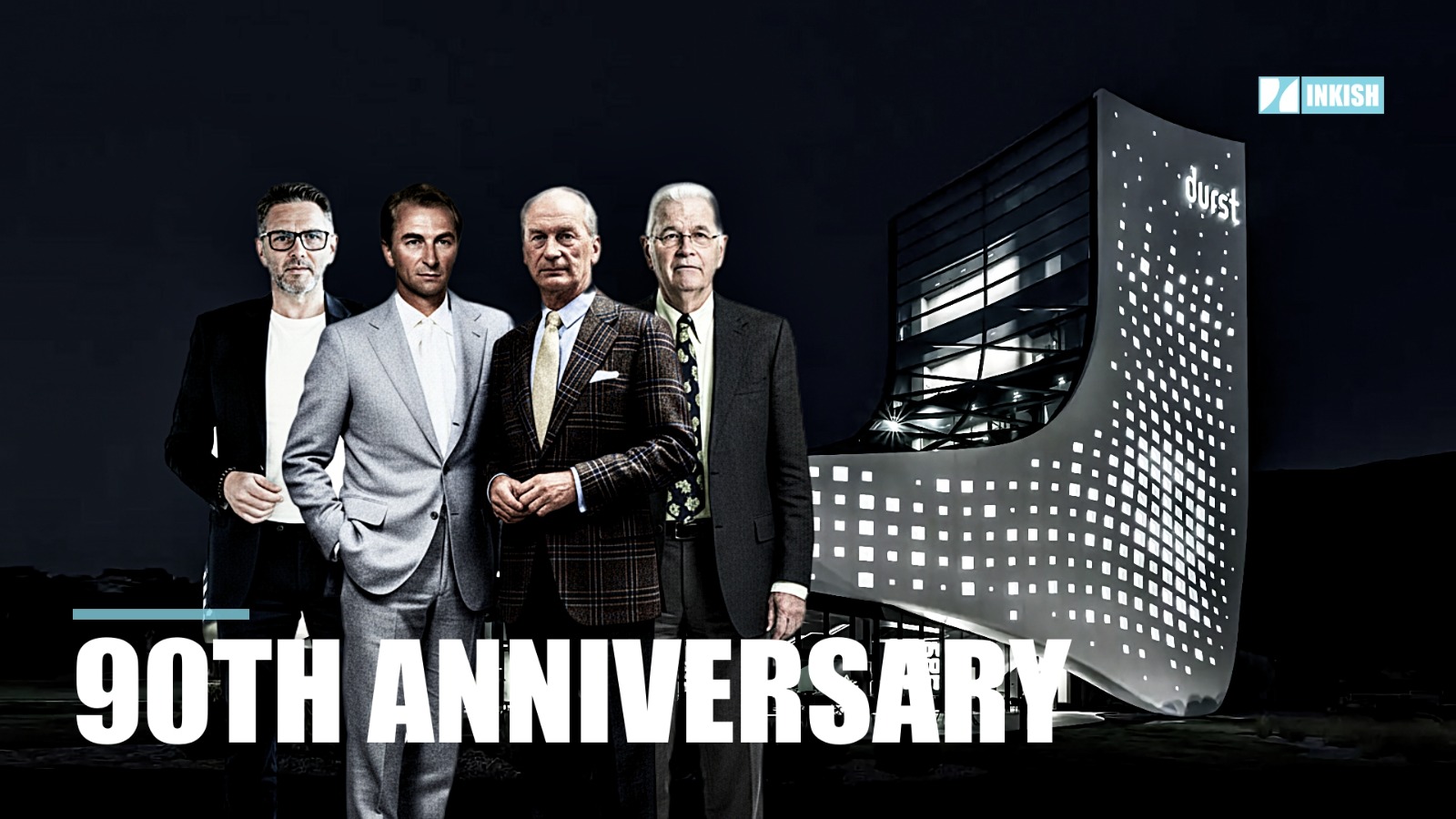
AI-generated image of Christoph Gamper, Gilbert Durst, Julius Durst, and Richard Piock.
We are only a few days into 2026, and DURST has already begun celebrating its 90th anniversary. The photos circulating on LinkedIn show people celebrating a history that has not only produced products used all over the world, but also a company that remains razor-sharp and clearly focused on growth. The internet often claims that CEO Christoph Gamper has transformed DURST from a product company into a platform company, but to understand that evolution, it makes sense to start at the beginning — in 1936.
Anyone who has visited Brixen knows how vital the mountains are. Almost every time I’ve been there, stories about mountain climbers or the greatness of the surrounding hills come up — a way of underlining how deeply DURST is connected to its region. After World War I, Italy annexed South Tyrol, and by 1936, the area was ruled by fascist dictator Benito Mussolini. As with most dictators, Mussolini sought to erase what came before. Cities were renamed, German schools and newspapers were closed or censored, and even surnames were forcibly changed from German to Italian. Thousands of Italian workers were sent to South Tyrol as part of a deliberate effort to dismantle German culture.
Brixen became Bressanone, and Julius and Gilbert Durst founded the company in an old brewery. This location turned out to be ideal, with solid floors for machinery, stable conditions, and, perhaps most importantly, the place where everything began.
The Durst family name can be traced back to at least the 1600s, possibly even the 1500s, and is a respected German surname in South Tyrol. German roots have always mattered, and even today, visitors to DURST will notice that German or English is more commonly spoken than Italian. When DURST was founded in 1936, at the height of Mussolini’s campaign to Italianize names, the company avoided being forced to change its own. Historical sources suggest that, despite its German background, DURST used Italian exclusively as its official language and that the company’s registration papers listed the Italian name for Brixen to avoid unnecessary attention from authorities.
Before 1936, Julius and Gilbert Durst repaired cameras, but they were also developing a prototype that would later become one of the first products of Durst Phototechnik AG.
DURST initially produced cameras, but it was the enlargers that truly mattered. At the time, Europe was fragmented, with countless small manufacturers in each country mainly serving local markets. DURST made a different decision early on, choosing to operate internationally and export its products. The enlarger, in particular, became a success and helped establish DURST as a global name long before globalization became a management buzzword.
In 1939, South Tyrol once again found itself in political turmoil. Hitler and Mussolini had become allies, and many South Tyroleans hoped that Hitler would act as their protector. Instead, the situation worsened. The population was given a brutal choice: emigrate to Nazi Germany or remain and accept full Italianization.
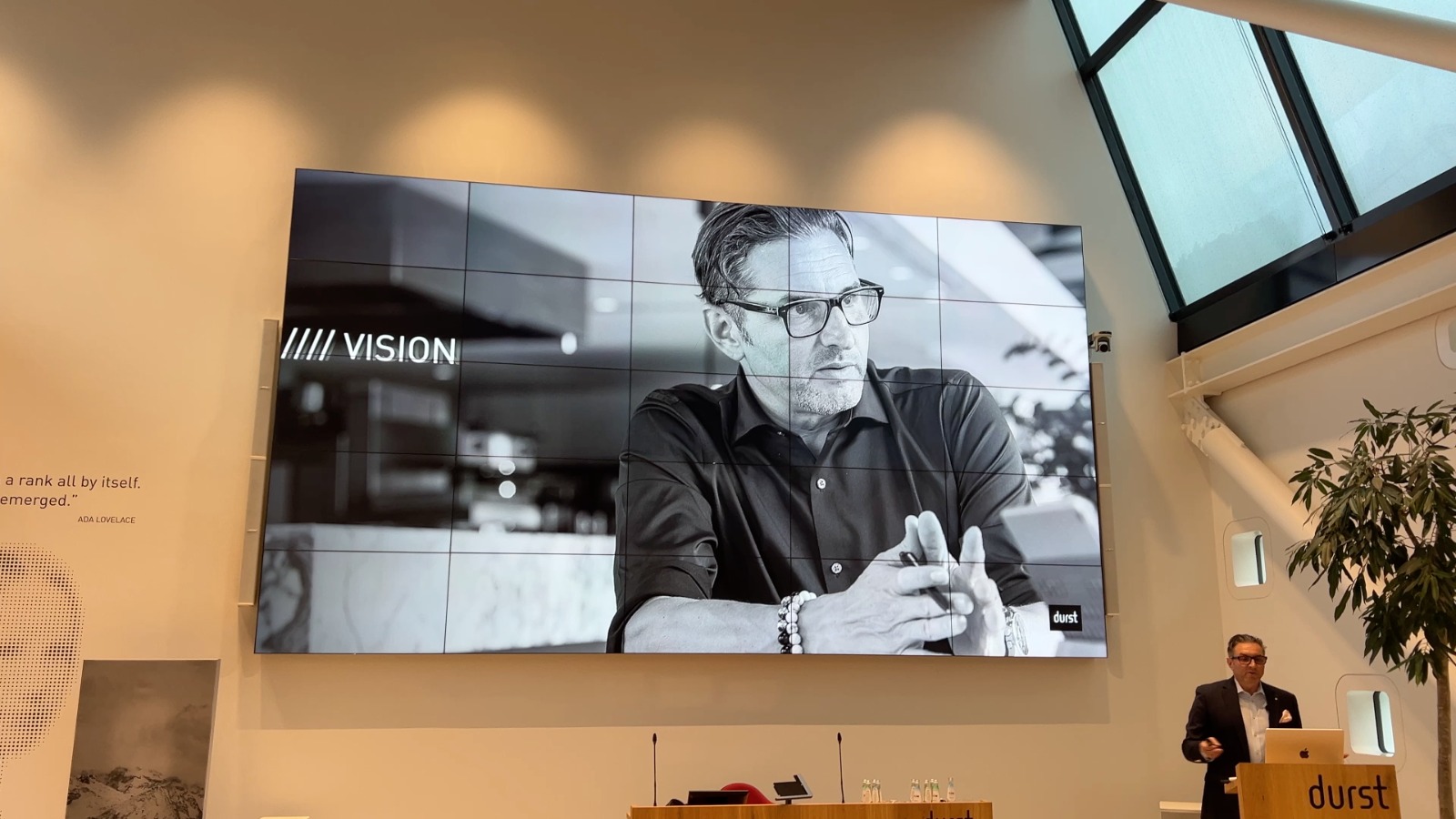
Today, South Tyrol is part of Italy. Yet many Italians will tell you that South Tyroleans are different — not quite Italian. In Austria, there seems to be little appetite for revisiting old borders. Caught between cultures and mountains, South Tyrol blends Italian food, design, and architecture with German precision, engineering, and discipline — a combination that is hard not to admire.
DURST largely stayed out of the war, primarily because it was a small company — too small to produce military equipment and not significant enough to be forced into doing so. Like many others, however, it struggled with supply constraints that limited production.
From the late 1940s through the late 1980s, DURST developed steadily. The company worked on autofocus camera technology alongside other industry players while continuing to sell enlargers. At the same time, competition intensified. European manufacturers grew stronger, and Japanese companies began delivering high-quality products at prices European firms couldn’t match. Even then, DURST repeatedly chose specialization over scale — a pattern that would quietly define the company’s strategy for decades to come.
That change accelerated in the early 1990s when Richard Piock became CEO of DURST. Rather than inheriting a transformed company, he spent roughly two decades reshaping it. Piock is a private figure, and little is written about him, but his focus on operations and innovation proved decisive. Under his leadership, DURST became a supplier of printing equipment. The Lambda, launched in 1994, was embraced by museums, galleries, and high-end photo labs. It was a large-format printer that exposed photographic paper using three laser beams — red, green, and blue — before chemical development, just like traditional photography.
No pixels, no banding, no gradient issues — just exceptional quality, albeit with the drawback of requiring specialized paper and chemicals.
In 2013, Christoph Gamper became CEO of DURST and a co-owner. Born in 1970, he continued the company’s transformation, discontinuing legacy products and driving inkjet solutions across ceramics, textiles, large format, and labels. For many insiders, the move into ceramic inkjet was more than diversification — it was a decisive moment that reshaped DURST’s future and provided both financial stability and technological confidence. Suddenly, DURST seemed to be everywhere.
Gamper understood the importance of visibility — in the market, in the industry, and especially within the community. The original headquarters from 1936 had already been replaced in 1963, and in 2019, the site was expanded with a tower where each window is referred to as a “pixel.” The lighting can simulate different scenarios, even if appropriately, at a low resolution.
Gamper has often been described as a platform CEO, and the description fits. Under his leadership, DURST built a strong software division and created Kraftwerk — German for “power plant.” Kraftwerk serves as an incubation hub, providing startups and smaller acquired companies with space to develop, either to become part of the DURST Group or to be spun off, depending on what makes the most sense. Like many industrial players, DURST has recognized that the future isn’t just about machines, but about where value, data, and margins ultimately reside.
DURST has made targeted acquisitions to strengthen its AI and software capabilities, as well as acquiring Vanguard Digital Printing, a US-based manufacturer of large-format printers. From early January, a delighted C17 user in Toronto can be seen in a film we recorded for Ultimate Tech just before Christmas 2025 on INKISH.TV.
In 2019, DURST also entered a joint venture with Koenig & Bauer, forming Koenig & Bauer Durst, managed by Daniel Velema, to focus on inkjet solutions for corrugated and folding carton. The VariJet, in particular, is highly anticipated. DURST also maintains a formal partnership with OMET, delivering flexo-hybrid solutions. In 2025, the company acquired Callas and launched the Open Software Initiative — perhaps more open in name than in practice, but rooted in a necessary and straightforward idea: software that can actually communicate.
Today, DURST operates globally with a significant installed base across multiple continents, supported by both local subsidiaries and long-term partners. Being family-owned has allowed the company to think long-term — sometimes slower, often bolder, and mainly without the pressure of quarterly expectations. Not every initiative succeeded, and some technologies were abandoned along the way, but the willingness to stop as well as start has been part of DURST’s discipline.
Of course, DURST is not a one-man operation. As strong as Christoph Gamper’s leadership is, the company’s progress depends on a deep bench of talented people. Christian Harder, Thomas Macina, Andrea Riccardi, and many others play essential roles across the business and are fundamental to the growth we see today.
Let’s end the story here. DURST is now 90 years young, and the future looks bright. The company sells its technology globally, operating through both partners and its own entities. It’s never easy to predict where the next innovation will come from. Still, with a strategy built around ambition, specialization, and a consistent focus on aiming high, it seems likely that DURST will be around for many years to come.
Warm congratulations on your 90th anniversary from INKISH — and hope to see you soon.

Proofed (Human)

Listen to This Article

Loading...

Login
New User? Signup
Reset Password
Signup
Existing User? Login here
Login here
Reset Password
Please enter your registered email address. You will recieve a link to reset your password via email.
New User? Signup
Currency Exchange Graph