By Editor Morten B. Reitoft
It’s been a while since I last wrote about Landa Digital Printing, but there are reasons to revisit the story. When Landa was acquired by the private equity company FIMI in 2025, my immediate thought was that turning the company around would be an almost impossible task. Leading up to the acquisition, the headlines were not flattering—unpaid bills, dissatisfied customers, quality issues—and while we, along with others, covered these developments, we also visited Landa in Israel just before drupa 2024.
That visit was, in many ways, surprising. Landa was open. Not defensive, not dismissive—just open. Our criticism over the years hasn’t really been about the challenges themselves, but rather the lack of transparency around them. Most of the customers we’ve spoken to understood the risk. Investing in Landa was never a safe bet—but it was potentially a transformative one. If nanography could deliver on its promises from drupa 2016, the upside was unlike anything else in the market.
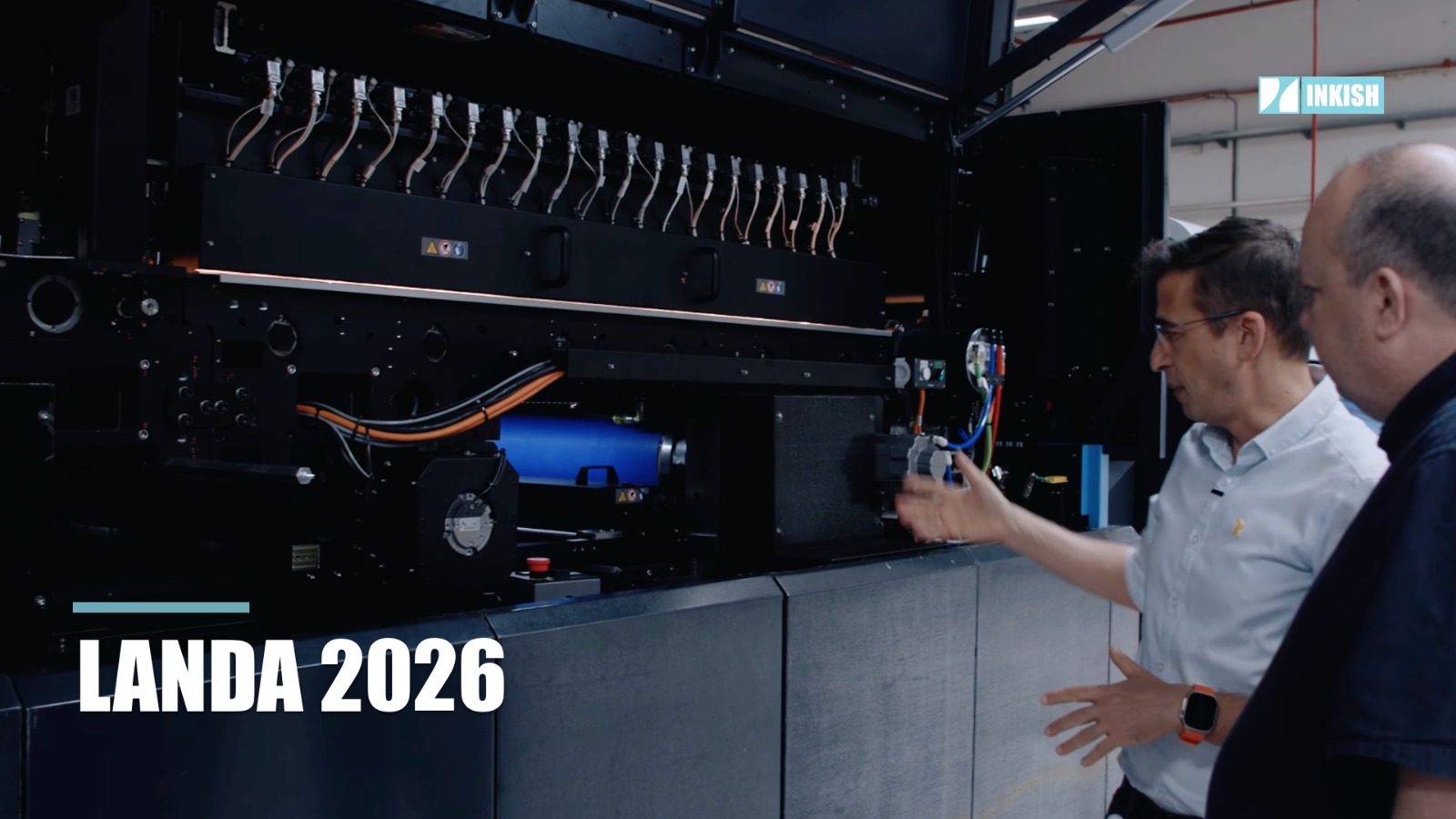
And the potential is real. Seeing Fujifilm Samba printheads jet an almost invisible layer of ink onto a heated belt and then transfer a stunning image onto virtually any substrate is impressive. It’s different. It’s clever. It’s unique. But it also immediately raises a fundamental requirement: the transfer must be perfect. Not almost perfect—perfect. Anything less, and you risk contamination from previous images. That alone is a serious engineering challenge.
Which brings me to something that puzzled me during our visit. When we saw the S11P—the faster evolution of the S10—the focus wasn’t really on the elegance of the transfer process. The increased speed seemed primarily enabled by increased drying capacity, including upgraded NIR. More energy. More drying.
And that leads to a simple question: why?
If the idea is to transfer an almost dry polymer film from the heated belt, why is heavy drying still required after transfer?
The answer, as far as I can see, is that “almost dry” is not enough. Just like any other water-based inkjet system, the remaining moisture needs to be fully removed to ensure stability, durability, and consistency. If not, you either need additional processes—like inline coating—or slow the press down. And since speed is one of the most critical KPIs for any Landa investment, the solution becomes obvious: add more drying.
It’s not a criticism—it’s a reality. But it does shift the narrative slightly. Nanography doesn’t eliminate drying. It redistributes it—and then reinforces it.
Since FIMI took over, there has been very little communication about direction, progress, or priorities. No real insight into what has been fixed, what remains a challenge, or where the company is heading. I had a brief exchange with Yarden Ben-Dor, who was positive but also indicated that it might be too early to share much. Fair enough. But then, shortly after, a press release appears about a Chinese customer buying a second press.
That raises questions.
Not necessarily about the deal itself—but about context. Landa has, in the past, been associated with aggressive commercial models, including installations tied closely to performance agreements. I was told this wasn’t the case here, and I have no reason not to believe that. Still, when a company with this history goes quiet for a long period and then resurfaces with a positive announcement, it invites scrutiny.
Because the alternative is not an option. The machines cannot be sold the way they were before.
And that becomes even clearer when looking at the secondary market.
Recently, I came across a Landa S10P listed for sale on PressXchange. A machine from late 2022, now on the market in early 2026. If we assume even moderate utilization—two shifts, 70% uptime, 4,000 sheets per hour—you would expect close to 50 million sheets over three years. The actual number? Around 2.3 million.
That’s not a gap. That’s a statement.
It doesn’t explain everything, of course—but it raises the most important question of all: are these machines being used as intended?
This is why Landa needs to communicate more clearly.
What is the plan under FIMI?
What has been learned from the first installations?
Have the consistency issues been resolved?
What about the cost and lifetime of consumables like blankets?
And perhaps most importantly, what is the real energy footprint when combining heated belts, NIR drying, transport systems, and optional UV?
These are not unfair questions. They are necessary.
Because the market has changed. When Landa was introduced in 2012, the landscape was very different. Today, multiple vendors offer highly productive inkjet solutions—mostly in B2, yes—but often with higher speeds and increasingly stable performance.
Which brings me to a final question I’ve been thinking about.
For packaging, B1 makes perfect sense. Format drives efficiency. But for commercial print, does it still?
A B1 press means more printheads, more complexity, higher investment, and often more demanding finishing requirements. In a world of shorter runs, faster job changes, and increasing automation, is bigger always better—or has the sweet spot moved?
I don’t have the answer. But I think it’s a question worth asking.
Landa remains one of the most ambitious—and most fascinating—stories in our industry. The vision is still compelling. The technology is still unique. But today, more than ever, the conversation needs to move from potential to performance.
Until that happens, the industry is left not with answers—but with questions.

Proofed (Human)

Listen to This Article

Loading...

Login
New User? Signup
Reset Password
Signup
Existing User? Login here
Login here
Reset Password
Please enter your registered email address. You will recieve a link to reset your password via email.
New User? Signup
Currency Exchange Graph