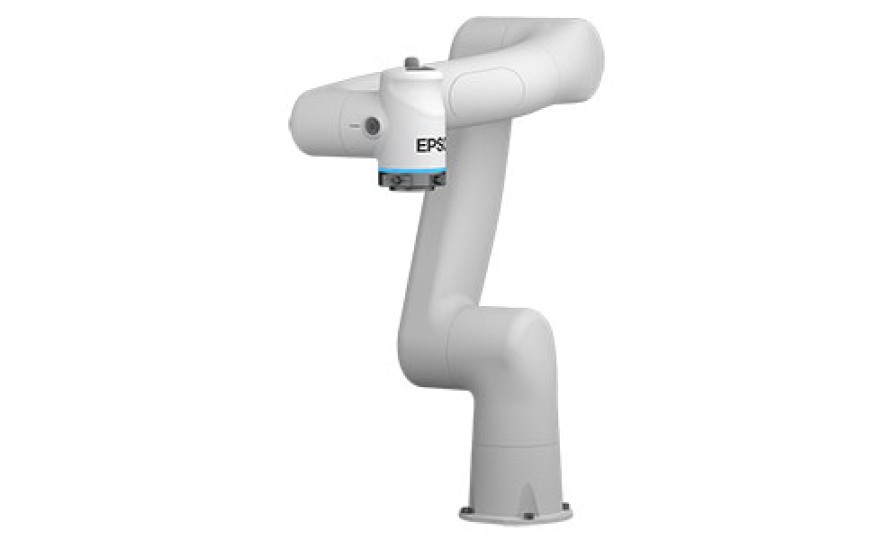
Epson has announced the development of its first collaborative robot (cobot), marking a major expansion of its automation portfolio beyond traditional manufacturing. Slated for launch in 2025, the new cobot is designed to serve a wide range of industries—including life sciences, pharmaceuticals, manufacturing, and logistics—with initial availability in Japan and Europe, and a phased global rollout to follow. This move reflects Epson’s commitment to delivering advanced automation solutions that meet the evolving demands of modern industries.
Leveraging over 40 years of expertise in industrial robotics, Epson’s new cobot addresses growing market needs for precision, flexibility, and ease of integration. Designed with smooth contours and an intuitive head-mounted control button, the robot is built for cleanroom environments where strict hygiene standards are critical. With skilled labor shortages and increasing pressure for efficiency, Epson’s entry into collaborative robotics aims to bridge gaps in both industrial and laboratory workflows.
Key features include a lightweight robot arm with a 6kg payload and 900mm reach, optimized for easy deployment in confined or reconfigurable spaces. Weighing only 17kg, the arm can be relocated with minimal effort, while a compact controller—measuring under 6kg—supports integration with mobile robots such as AGVs and AMRs. The system supports a wide range of power sources (100–230 VAC and 48VDC) and is engineered to comply with ISO 14644-1 Class 5 cleanroom standards and IP54 protection, making it well-suited for use in highly controlled environments.
Another standout feature is Python programming support, allowing easier adoption by users already familiar with the popular language. This flexibility benefits both system integrators and R&D professionals, enabling faster customization and deployment without the need to learn proprietary code. With its clean design, compact size, and programming versatility, Epson’s new cobot is poised to support automation strategies in sectors requiring both precision and adaptability.




Login
New User? Signup
Reset Password
Signup
Existing User? Login here
Login here
Reset Password
Please enter your registered email address. You will recieve a link to reset your password via email.
New User? Signup
Currency Exchange Graph