Switzerland is one of the wealthiest countries in the world, and it’s also one of the most expensive countries to operate your business. Nature is endless, beautiful, and harsh. You have four cultures/languages (German, French, Italian, Romansch), and a friendly, hard-working, and very innovative population. A total of 9 million people live in the 41,285 km² (15,940 sq mi) large country. Politically, a conservative country with one of the world’s most developed local democracies, characterized by numerous local referendums, the country has 26 cantons that each have their own parliaments, court systems, and other governing structures.
Switzerland is renowned for its strong fintech companies, as well as its chocolate, perfumes, chemicals, pharmaceuticals, and, in our industry, giants such as BOBST, Gallus, Hunkeler Systeme, SIG, Ferag, Packsys, Wifag, Müller Martini, Hunkeler, Matti Technology, and Kern, to name a few.
The total export of the above companies to the US is hard to get, but a conservative estimate is $500 million annually (with SIG and BOBST as the biggest). With a 39% tariff, American customers will pay a staggering $195 million more for the same products.
The official reason for the increased tariff on Switzerland (and the US and Switzerland are currently negotiating trade deals) is the US/Swiss trade deficit. When traveling in America, several people have asked me, but it’s not fair that there is a trade deficit. Many also say that they feel they are being taken advantage of by countries that sell more to the US. But friends! How can a country with 9 million people ever achieve a trade balance with the US? You have 300 million people, so there is no logic to this claim. If 300 million people like Swiss chocolate, they will buy it, and they will consume more than the Swiss people can consume of whatever product they buy from the US. In a capitalistic system, having a trade deficit is not in itself bad because the way it’s balanced is through payments. Nobody would buy Swiss chocolate at any given price if it weren’t because the consumer considers this chocolate worth the price tag. If they find it too expensive or don’t like it, the customer can buy chocolate from an American producer or elsewhere. The competition is what keeps prices and quality in line, driving us all to innovate.
The same applies to equipment from the above companies. When you buy a BOBST machine at a premium, it’s simply because you find it more valuable than a competitor from China. Or when you invest in a Müller Martini binder because it meets your needs better than any other in the market, and so forth.
However, 39% is ultimately considered a severe trade barrier, and it will influence the market in the following way.
- It will lower demand for Swiss-made equipment
- It will force a significant tax on imports for the Americans investing
- The lower demand will eventually make the Swiss company smaller
But there are not many things to do. One of the promising developments is that on Friday, August 29th, a federal court ruled against Trump’s tariffs, specifically imposing taxes on Americans without the consent of Congress - read more here from MSNBC.
If the US Administration loses the appeals on the above, they would be obligated by law to repay all the collected tariffs.
I don’t know if the technology could be developed under license or if daughter companies have value here.
As written a couple of days ago, the direct consequences are more on the financing side, as the durability and volume produced balance the extra cost. However, assuming it is financed over five years, it is not possible to match - even with a zero percent interest rate.
If the product you sell is complex in the sense that it is build of, i.e., software and hardware, you can consider the legal action to separate the software (zero tariff) and hardware (39%). If the software is required for the machine, it would not be legal, but if the software is sold separately and has stand-alone functionality, this could lower the price, and therefore also the total tariffs. This maneuver could be deemed illegal if the only reason for doing it is to avoid taxes.
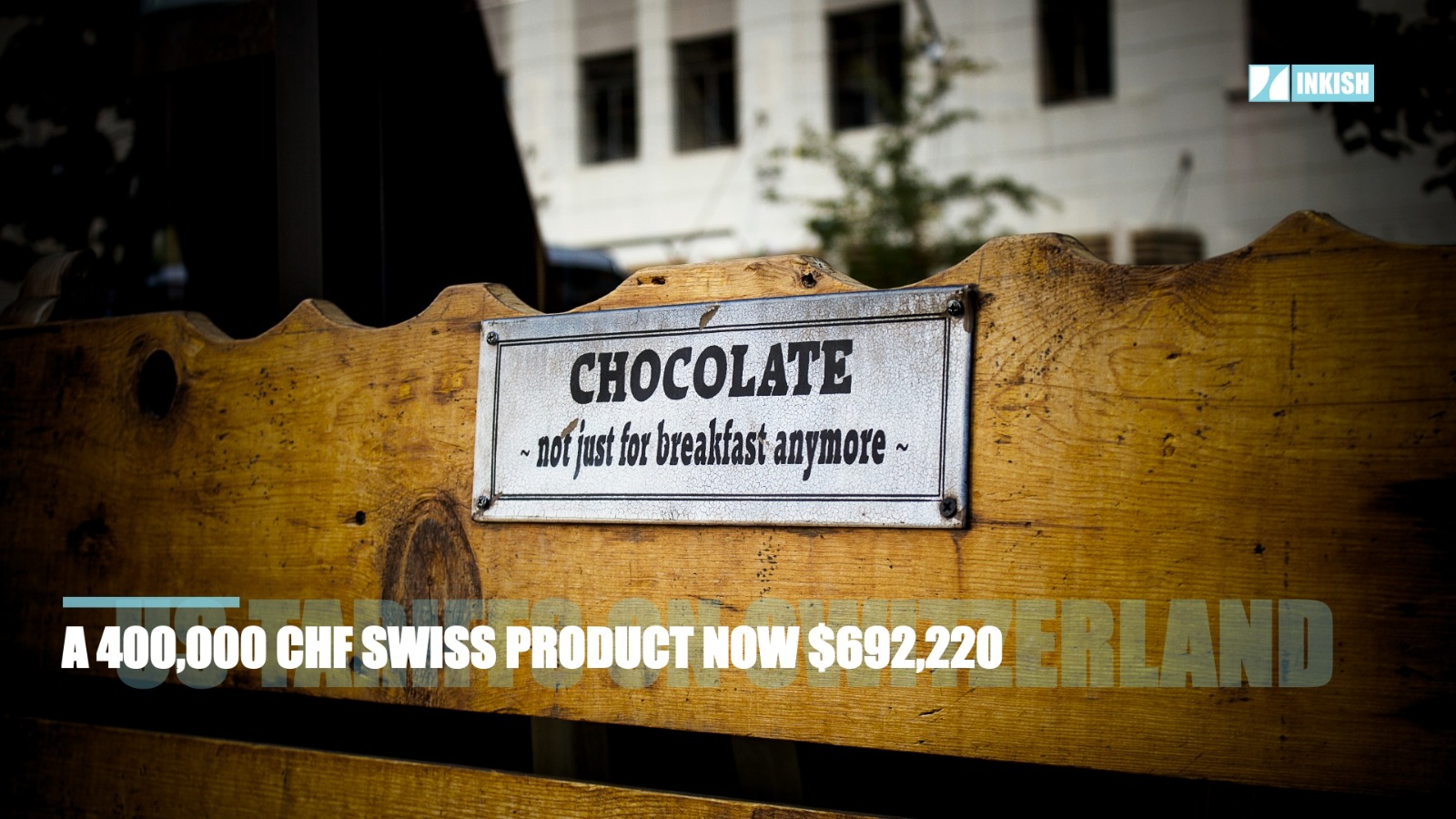
The consequences are severe - a 400,000 CHF binding machine would, with today's exchange rates and tariffs, translate to a value of $440,812 to $692,220 in today's dollars.
Nobody can absorb this kind of money, and for American companies investing in Swiss technology, the productivity gain must be double digits, if not beaten by internal competition. The bigger issue for American printers is that this gives Canadian and Mexican printing companies significant incentives to sell in the US, as printer paper/packaging is part of the USMCA agreement and is therefore exempt from tariffs. The US Administration essentially pushes production out of the US, and this is particularly true for technology that, for the most part, isn’t produced in the US - amazing!
The Swiss companies, however, have several options. They can sell more in both Europe and, for sure, in the emerging markets. The middle class in LATAM, South Africa, and India grows faster than in the developed market, influencing the GDP, which again influences demand for print and packaging. The fastest and highest growth is seen in India, with steady and stable growth in South Africa. In select countries in LATAM, such as Brazil, Mexico, Colombia, and Chile, the CAGR of GDP and print consumption is 3-5% annually.
There are, of course, other significant challenges in the emerging markets, but it’s time to move into these markets and be ready to compete with the Chinese. And yes, price is a crucial parameter, which therefore also requires new product strategies.

Proofed (Human)

Listen to This Article

Loading...

Login
New User? Signup
Reset Password
Signup
Existing User? Login here
Login here
Reset Password
Please enter your registered email address. You will recieve a link to reset your password via email.
New User? Signup
Currency Exchange Graph