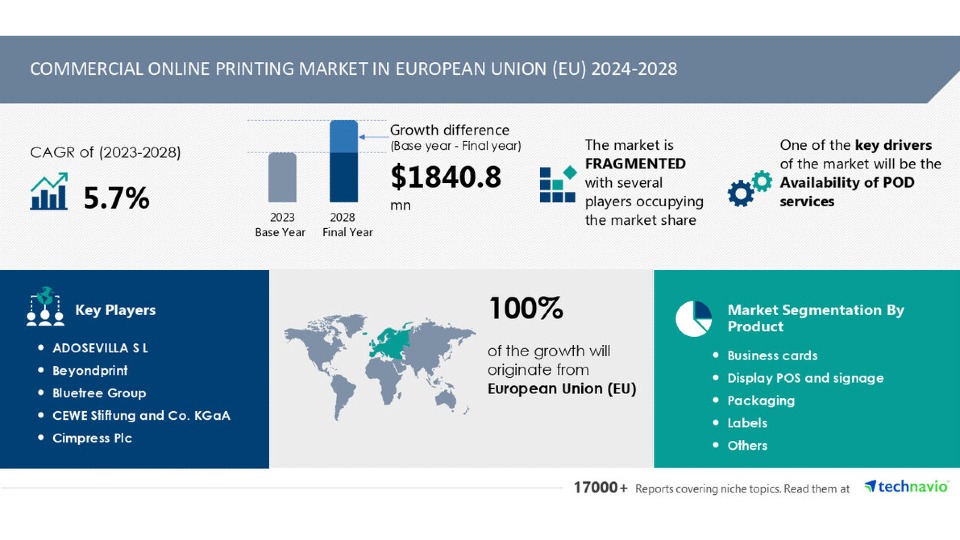
New York City, USA - The Commercial Online Printing Market in European Union (EU) size is estimated to grow by USD $1.84 billion from 2024-2028, according to global market research firm Technavio. The market is estimated to grow at a CAGR (compound annual growth rate) of 5.7% during the forecast period. Availability of print-on-demand (POD) services is driving market growth, with a trend towards development in communication network infrastructure. However, rising demand for digital advertisements and e-books poses a challenge.
Key market players include ADOSEVILLA S L, Beyondprint, Bluetree Group, CEWE Stiftung and Co. KGaA, Cimpress Plc, Doxzoo Ltd., Expresta s.r.o., FasterPrint Srl, Fiserv Inc., Grafenia plc, Helloprint United Kingdom BV, MOO Print Ltd., Northside Graphics Ltd., Onlineprinters GmbH, OvernightPrints GmbH, Printful Inc., and unitedprint.com UK Ltd.
Key Market Trends Fueling Growth
The EU boasts communication network infrastructure, which is fostering technological advancements and driving growth in various sectors. Countries such as the UK, Germany, Spain, Poland, Switzerland, Belgium, Italy, Luxembourg, Malta, and the Netherlands are prioritizing network infrastructure improvements. Europe's broadband coverage exceeds 95%, with average fixed and mobile broadband speeds surpassing the global averages (70.5 MB for fixed, 34.9 MB for mobile). Government initiatives, like the European Commission's 2016 broadband strategy, aim to upgrade download speeds to 1 Gbps for all EU households by 2025. To support this goal, countries are investing in communication network enhancements. These advancements are fueling the expansion of online printing services in Europe, with traditional printing vendors adopting web-to-print software and providing online services to customers. This technological progression is anticipated to boost the commercial online printing market in the EU during the forecast period.
The Commercial Printing Market in the EU is experiencing notable trends in logistics and warehousing, particularly in serving the retail sectors. Hybrid print technologies combine analog and digital methods, while online mediums boost print-on-demand (POD) solutions for input materials like pigments. Green commercial printers focus on sustainability, using eco-friendly raw materials such as paper. Market concentration is increasing with strategic alliances and economies of scale. Labels, tags, and packaging dominate, with gravure print process for labels and laser printing for tags. Newspapers continue to use offset printing methods, while digital technologies drive growth in books, direct mail, brochures, and catalogs. Companies like DS Smith Iberia in Lisbon, Portugal, leverage commercial inkjet products and litho lamination for various applications. The industry encompasses enterprises and commercial printers utilizing digital printing technologies to meet diverse customer needs.
Market Challenges
The EU commercial online printing market is experiencing a shift towards digital advertising, which is predicted to decrease the demand for traditional printed materials such as brochures, flyers, and posters. Outdoor and indoor digital signage, including backlit displays, LCD screens, and point-of-purchase (POP)/point-of-sale (POS) signage, are increasingly popular. Advertisers are drawn to digital advertising due to its wider reach, lower costs, and measurable results. Digital billboards offer advertisers the ability to display messages based on time, place, and geography, making them a cost-effective alternative to traditional advertising methods. Marketers are experimenting with new ways to use digital billboards, such as full-motion digital electronics signage, to promote a wide range of products at a low cost. This trend may pose a challenge to the commercial online printing market in the EU during the forecast period. The European Union (EU) commercial online printing market faces several challenges in the ink, printing materials, and chemical product sectors. The Packaging Segment, including folding cartons, flexible packaging, and label printing, presents significant opportunities for growth. Tobacco products and alcoholic beverages are major end-use segments. The e-commerce market's expansion, driven by companies like Amazon, eBay, and Target, fuels demand for commercial online printing services, including bulk printing, binding, composition, layout designing, and press productions. Xeikon's online services cater to various industries, including phone books, magazines, labels, business forms, promotional materials, training manuals, and advertising materials. Disposable income and consumer spending power influence the demand for luxury gifts and advertising needs from advertising firms. Digitization, smartphone camera capabilities, and social media applications impact communication network infrastructure and end-user industries. Faster presses and advanced printing techniques cater to digital media, while packaging and labeling remain crucial for various industries. The EU market must adapt to these trends and invest in AI-powered design tools and innovative solutions to remain competitive.
Research Analysis The Commercial Online Printing Market in the European Union (EU) is a significant sector, catering to the needs of various enterprises for high-quality printed materials. This market is driven by the increasing demand for digital printing technologies, which offer faster turnaround times and cost-effectiveness for short-run jobs. The EU market encompasses the production of books, direct mail, brochures, catalogs, and commercial inkjet products using both offset and digital printing. Raw materials, including paper and ink, play a crucial role in the industry's success. The Packaging Segment, which includes folding cartons, flexible packaging, and label printing, is a growing sector, with applications in various industries such as tobacco products, alcoholic beverages, and bulk printing. Additionally, services like binding, composition, layout designing, and press productions are integral to the market, ensuring the final product's quality and appeal.
The Commercial Printing Market in the EU is a significant industry serving various enterprises and commercial printers. This market is driven by the demand for digital printing technologies for producing books, direct mail, brochures, catalogs, and commercial inkjet products. Portugal's DS Smith Iberia in Lisbon is a notable player in the packaging segment, focusing on folding cartons, flexible packaging, and label printing. Raw materials like paper, ink, and printing materials are essential inputs. The market caters to diverse end-use segments, including tobacco products, alcoholic beverages, e-commerce marketplaces like Amazon and eBay, and retail sectors. Digitization, smartphone camera capabilities, and social media applications have influenced the demand for advertising materials such as pamphlets, faster presses, and printing techniques. Hybrid print technologies, such as AI-powered design tools, logistics, and warehousing, cater to the needs of advertising firms and businesses with varying advertising needs based on consumer spending power, luxury gifts, and promotional materials. The market faces competition from digitization, economies of scale, and strategic alliances. Offset printing methods and digital technologies coexist, with gravure print process being used for specific applications like cigarette packaging. The online medium, print books, and print-on-demand (POD) services are gaining popularity. Input materials like pigments and green commercial printers are also part of the market landscape.




Login
New User? Signup
Reset Password
Signup
Existing User? Login here
Login here
Reset Password
Please enter your registered email address. You will recieve a link to reset your password via email.
New User? Signup
Currency Exchange Graph