
If you're working in folding carton manufacturing with high-speed printing equipment, you're probably all too familiar with the dust contamination challenges we explore in this study. The dust generated from cutting, slitting, and inherent paper particles often overwhelms standard sheet cleaning systems, leading to those frustrating, frequent blanket washes and the production downtime that comes with them.
The good news? You're not alone in facing these challenges—they're remarkably consistent across the industry—and we've invested considerable time and effort into documenting practical solutions that work.
After extensive research across multiple facilities and equipment configurations, we're excited to share what we've learned about cost-effective approaches that can make a real difference in your operations. While every facility is unique in terms of size, production volumes, and equipment setup, our comprehensive analysis shows that the fundamental economics of these solutions remain consistently attractive. Most operations we've studied achieve payback periods that any business would find acceptable, making these improvements both practical and profitable.
This research represents months of careful field observations, data collection, and collaboration with industry professionals who generously shared their experiences. We've worked hard to present evidence-based solutions for dust mitigation at the source, enhanced cleaning technologies, and optimized maintenance protocols that you can implement.
We hope that by sharing these findings, we can help the entire industry move beyond what many have accepted as "unavoidable production challenges." The strategies detailed in this paper have already helped manufacturers achieve significant improvements in production efficiency, quality consistency, and overall profitability—and we believe they can do the same for you.
Keywords: cutting and slitter dust, converting operations, offset printing, blanket contamination, folding carton, sheet cleaning, production efficiency
During the production of folding cartons, significant amounts of particulate matter are generated in the cutting and slitting processes. This leads to a dual contamination issue: primary dust comes from the contact points of the slitter and cutting knives, while secondary dust originates from the surface of the substrate. Together, this combined contamination often overwhelms the cleaning systems, resulting in the rapid contamination of the blankets used in offset printing. Consequently, there are more frequent press washing cycles, increased production downtime, and challenges in maintaining quality control for the finished products.
Dust contamination in in-house converting operations is a well-known challenge in the industry. However, the introduction of advanced printing equipment has significantly changed the frequency and severity of these issues.
While the converting processes themselves have not changed, modern presses operate at much higher speeds—averaging 16,000 sheets per hour and with top machines like the Heidelberg XL 106 reaching up to 21,000 sheets per hour. This increased speed generates considerably more mechanical stress on substrates, leading to a greater release of particles, increased static charge buildup, and faster contamination of cleaning systems.
This technological advancement changes previously manageable dust levels into significant barriers to production. Traditional dust control measures, which were adequate for slower equipment, are now insufficient against the increased contamination rates caused by high-speed operations. As a result, comprehensive dust reduction strategies are essential for maintaining competitive production efficiency, rather than just being optional.
The economic impact affects the entire production chain, influencing the performance of the sheet cleaner system and the overall efficiency of the equipment. This situation leads to costly interventions, such as more frequent maintenance of printing presses for dust removal and increased filter cleaning to ensure optimal press feeding performance. Understanding these issues and implementing practical solutions is a critical operational priority for folding carton manufacturers aiming to optimize their converting and printing processes.
This paper discusses the analysis of the root causes of dust generation, engineering solutions for reducing sources of dust, the implementation of enhanced cleaning systems, and the optimization of maintenance protocols. It places particular emphasis on assessing the economic impact in a quantifiable manner. The focus is on practical solutions that can be implemented immediately, aimed at delivering measurable improvements in production efficiency and consistency in quality.
The cutting and slitting process generates particulate matter through mechanical shearing of substrate fibers, the wear of blades, static charge that attracts particles, and the fragmentation of substrate coatings. These mechanisms overlap, resulting in complex contamination patterns that vary based on the characteristics of the substrate, environmental conditions, and the maintenance status of the equipment.
It is essential to recognize that cutting and slitter operations are only one source of dust that can lead to production downtime. There are three well-known sources identified in converting and printing operations:
Cellulose Dust: Fine particles of wood fibers that are released from the surface of paperboard during handling and processing operations.
Coating Dust: Dust particles composed of coating materials such as clay, bonding agents, and titanium dioxide that separate from the substrate surface during mechanical operations.
Paperboard Debris: Larger fragments or particles of paperboard can break off during processes such as decurling, cutting, and slitting. This multi-source contamination leads to compounding effects, as different types of particles have varying adhesion characteristics, static behaviour, and cleaning requirements. Therefore, implementing comprehensive dust control strategies is essential for effective production management.
In the conversion process, the industry mainly depends on contact web cleaners equipped with anti-static bars and vacuum extraction systems located at the nip points. After conversion, during printing operations, more advanced solutions are employed. These include modern press systems that feature well-designed vacuum sheet cleaners with integrated anti-static bars, as well as traditional sheet cleaning brushes and air knives.
A significant limitation of modern press cleaning systems is their effectiveness at removing only surface dust. These systems have considerable difficulty handling cutting and slitter dust, which often accumulates a static charge. The unique characteristics of the particles produced during slitting, along with their increased attraction due to static electricity, can overwhelm these advanced cleaning systems.
Doyle sheet cleaner technology offers a practical, cost-effective, and efficient solution specifically designed for a wide range of manufacturing environments. It has proven effective in various applications, including converting operations at paper mills, in-house sheeter converting machinery, printing presses, and corrugated manufacturing facilities.
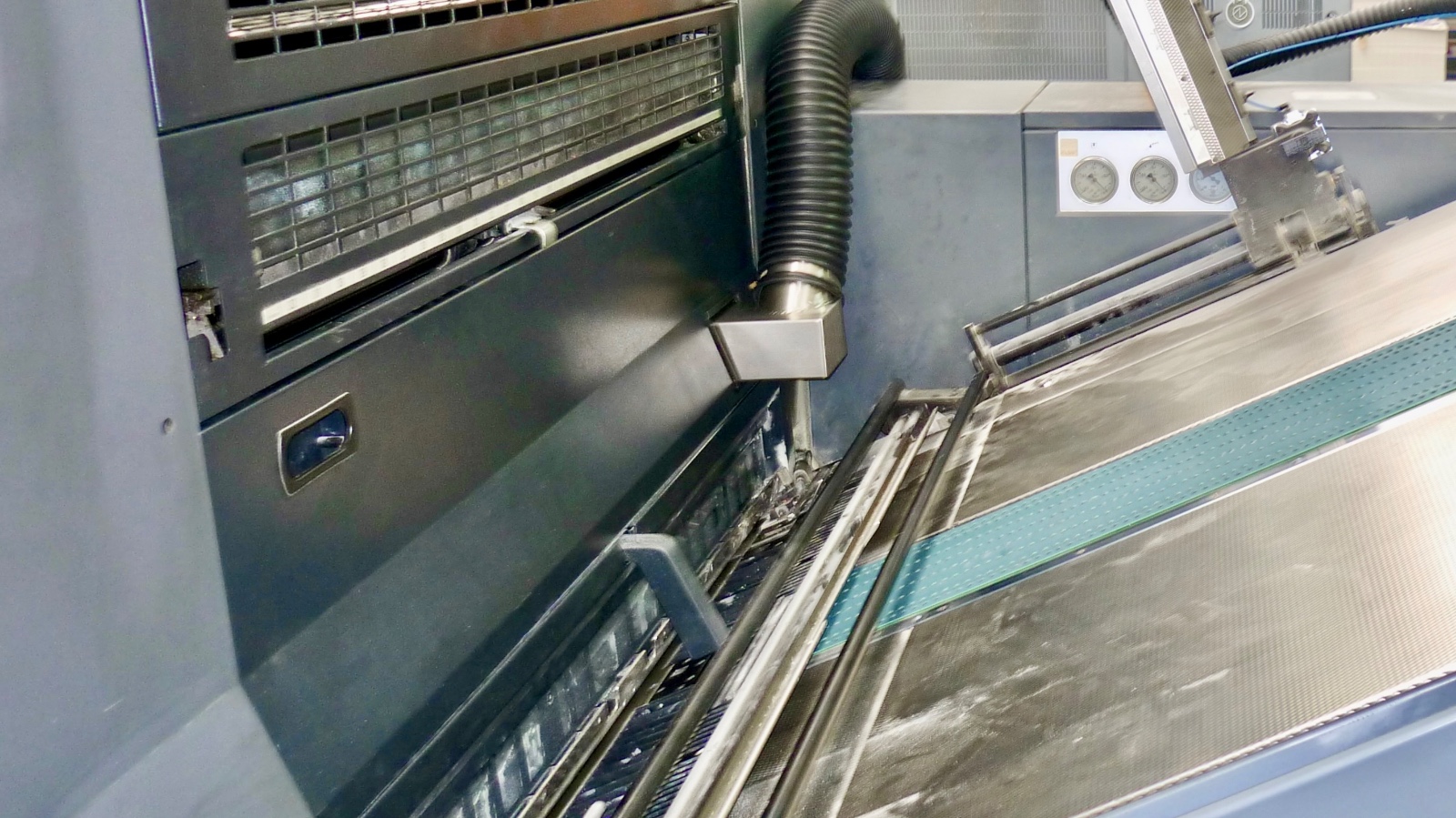
The versatility and proven effectiveness of Doyle systems make them an appealing choice for operations that need standardized dust control solutions in various production environments. Since most manufacturing plants do not have temperature and humidity-controlled settings, Doyle technology offers a practical aftermarket solution that delivers significant dust control benefits at a relatively low capital investment.
This gap between current cleaning capabilities and the actual challenges of contamination highlights the need for more comprehensive strategies.
These strategies should prioritize addressing dust generation at its source instead of relying solely on downstream cleaning systems.
Current standards highlight the importance of optimizing blade geometry and establishing regular maintenance schedules as key components for effective dust control. However, field observations show that dust contamination from cutting and slitters is seldom an issue when cardboard substrates are processed at paper mills under controlled conditions. The problem mainly arises during in-house conversion operations, where maintenance protocols are often insufficient, anti-static systems are not properly calibrated or serviced, vacuum systems operate inefficiently due to poor maintenance, and cleaning systems are poorly integrated.
Environmental factors significantly influence dust generation and behaviour. For example, temperature fluctuations can affect substrate moisture content and the accumulation of static charge, while humidity levels have a direct impact on particle adhesion and electrostatic attraction. Many manufacturing facilities lack comprehensive environmental control systems, making dust management more challenging. This underscores the need for robust and adaptable cleaning solutions that can perform effectively under varying conditions.
The industry's shift to high-speed printing equipment has highlighted significant shortcomings in traditional dust control methods. While the fundamental converting processes remain unchanged, new equipment now averages 16,000 sheets per hour, with top presses reaching up to 21,000 sheets per hour. This speed far exceeds the capabilities of earlier dust management strategies.
The exponential relationship between processing speed and dust generation means that solutions that were effective at 8,000-12,000 sheets per hour are inadequate under modern high-speed conditions. This explains why in-house converting operations that were once acceptable now face critical contamination levels, significantly affecting production efficiency.
Effective dust control requires systematic measurement approaches that utilize laser diffraction or cascade impactor techniques to characterize particles ranging from submicron to several hundred microns in size. To quantify the generation rate of dust, controlled testing is conducted under varying operational conditions, measuring particle concentration through gravimetric sampling or real-time particle counters.
Spatial distribution mapping is essential for identifying critical accumulation zones and determining optimal placement for capture systems. Additionally, temporal monitoring reveals patterns related to blade wear, changes in substrate, and fluctuations in environmental conditions.
The condition and geometry of the cutting blade significantly affect dust generation; dull or damaged blades can exponentially increase particle production. Optimizing cutting speed and pressure is essential for balancing production requirements with dust minimization. Furthermore, substrate characteristics—such as coating type, basis weight, and moisture content—also influence particle generation rates. Environmental conditions create complex interactions that affect both dust generation and electrostatic behaviour.
Industry benchmarks indicate that optimal operations can achieve between 10,000 and 15,000 impressions before a blanket washing cycle is needed, provided that proper colour sequence management is in place. In contrast, problematic operations may require washing after as few as 1,000 impressions, resulting in a 10- to 15-fold increase in washing frequency.
Another often-overlooked issue arises during the printing process itself. The migration of paper dust and slitter dust to ink rollers leads to significant contamination, affecting both ink transfer consistency and print quality.
Additionally, contamination in the dampening system, caused by dust particles, disrupts the critical water-ink balance needed for offset printing. As a result, the filters in Technotrans' intermediate and primary tank recirculation systems need to be replaced much more frequently due to dust contamination. Some companies opt to implement secondary filtration systems to minimize cleaning requirements for the dampening system, which increases both capital and operational expenses associated with inadequate dust control.
Operational parameters reveal that with mechanical press speeds of 16,000 sheets per hour at maximum capacity, each blanket wash cycle takes 3 minutes, including setup and restart time. Additionally, there is a startup waste of 20 to 30 sheets required before print stabilization. These factors contribute to substantial differences in overall equipment effectiveness.
Reference Production Parameters: A press that operates at a production speed of 16,000 sheets per hour typically averages 12,000 sheets per hour. This average includes standard activities such as plate changes, makeready processes, and roller washing associated with colour changes.
Normal Operations Baseline: Under optimal conditions, the first three printing units undergo blanket washing every hour, while all printing units are washed every two hours during extended production runs. This practice represents the industry standard for well-maintained operations with effective dust control.
| Operational Scenario |
Normal Operations |
Critical Dust Contamination |
Impact Difference |
| Blanket Wash Frequency |
Every 60 min (first 3 units), Every 120 min (all units) |
Every 2,000 impressions, (Every 10 minutes) |
6x increase in frequency |
| Downtime per Hour |
4-5 minutes |
18 minutes |
4x increase |
| Time Efficiency |
92% productive time |
70% productive time |
22% reduction |
| Effective Production Rate |
11,200 sheets/hour |
8,400 sheets/hour |
2,800 sheets/hour loss |
| Daily Production Loss |
Baseline |
28,800 sheets |
28,800 sheets additional |
| Startup Waste per Day |
Minimal |
3,750 sheets |
3,750 sheets additional |
| Weekly Impact |
Baseline |
7,488,000 sheets |
7,488,000 sheets additional |
| Annual Startup Waste |
Minimal |
975,000 sheets |
975,000 sheets additional |
| Total Annual Impact |
Baseline |
8,463,000 sheets |
8,463,000 sheets lost |
| OEE Reduction |
Standard efficiency |
30% reduction |
30% loss in utilization |
This indicates a 30% decrease in effective equipment utilization compared to normal operations. This figure does not include additional costs related to increased solvent use, cleaning materials, and accelerated wear of blankets in automatic washing systems.
The financial implications extend beyond simply calculating production rates. Direct costs include increased labour for maintenance, higher consumption of cleaning chemicals and replacement filters, and accelerated wear of press components. Indirect costs involve quality-related waste, customer satisfaction issues due to delayed deliveries, and opportunity costs from reduced capacity utilization.
For typical operations running 6,000 hours annually, the performance difference translates to approximately 71 million fewer sheets produced, resulting in significant revenue loss.
Additionally, the frequency of Technotrans filter replacements increases from quarterly to weekly, leading to an increase in operational costs. Moreover, installing secondary filtration systems usually requires a capital investment ranging from $50,000 to $150,000, depending on the press configuration.
Breaking down the financial impact to individual units reveals how minor inefficiencies compound into substantial losses. Each component—from a single wasted sheet to an additional blanket wash cycle—represents quantifiable costs that accumulate rapidly under critical dust contamination conditions.
|
Unit Cost (USD) |
Additional Frequency (Annual) |
Compounded Total (USD) |
|
| Single wasted sheet |
$0.06 |
975,000 sheets |
$58,500 |
|
| Additional blanket wash cycle |
$12.50* |
2,160 cycles** |
$27,000 |
|
| Prodution time lost per cycle | $60.00*** | 2,160 cycles |
$129,600 | |
| SubTotal: Quantifiable unit Impacts |
$215,100 |
|||
| Lost production opportunity | 7,488,000 fewer sheets | $449,280 | ||
| Total Annual Impact |
$664,380 |
*Includes solvent, labor, and cleaning materials per 3-minute cycle
**Based on washing every 10 minutes vs. baseline hourly schedule
***Based on $60/hour effective production value during 3-minute downtime
This unit-level analysis demonstrates how individual inefficiencies multiply exponentially.
An additional blanket wash cycle, which costs USD 72.50 in direct and opportunity costs, is performed 2,160 times each year under critical dust conditions. This means a minor operational adjustment results in a significant financial impact that far surpasses the investment needed for comprehensive dust control systems.
Market Value Impact Assessment: Typical market values in packaging manufacturing vary by application:
Conservative ROI Calculation: Using $60 USD per 1,000 sheets average for mixed production:
This compelling business case demonstrates that dust control investments pay for themselves within the first month of implementation, with subsequent benefits flowing directly to operational profitability.
Effective dust reduction starts with optimizing blade technology by using high-performance materials that have superior surface finishes. These finishes help reduce particle generation by minimizing friction. Precision in blade geometry, which includes specific rake angles, clearance settings, and edge profiles, is crucial for minimizing substrate disturbance while maintaining cutting efficiency. Advanced coatings, such as diamond-like carbon or ceramics, not only reduce friction but also extend the blade's lifespan. Additionally, the optimized angles and clearances must be precisely adjusted based on the characteristics of the substrate being cut.
Controlling cutting parameters presents significant opportunities for optimization. By adjusting the speed, it is possible to reduce particle generation by 30-50% compared to operating at maximum speed, while still meeting production requirements. Adjusting pressure ensures that cutting force remains adequate without causing excessive compression, which can lead to increased dust generation. Temperature control helps prevent coating degradation and minimizes static buildup.
Static elimination technology incorporates ion generation systems positioned strategically 6-12 inches downstream from cutting points for optimal charge neutralization. Integration with existing cleaning systems requires careful coordination to avoid interference while maximizing combined effectiveness. Monitoring and feedback control systems provide real-time assessment of static charge levels and particle generation rates, enabling automatic intensity adjustment.
Custom intake hoods are strategically positioned at nip points, utilizing computational fluid dynamics optimization to ensure effective particle capture without deflecting the web. Variable suction control automatically adjusts extraction rates based on the substrate type and cutting speed. Additionally, a multi-stage filtration system provides progressively finer particle separation, accompanied by automated monitoring and replacement alerts.
Air knife technology uses a laminar flow design to remove particles while reducing air consumption and noise levels efficiently. The adjustable pressure and angle controls allow for precise tuning based on the characteristics of the substrate and the level of contamination. Integrating vacuum recovery systems helps capture removed particles, preventing them from being redistributed, while a temperature-controlled air supply ensures consistent performance under varying environmental conditions.
When selecting and implementing this technology, it is essential to consider the constraints of the facility, compatibility with existing equipment, and operational requirements. Retrofitting existing systems is often the most cost-effective approach, especially for facilities without environmental controls. In such cases, robust and adaptable systems tend to perform better than alternatives that are highly dependent on precision.
The implementation of comprehensive cut and slitter procedures, along with surface dust reduction methods, marks a significant advancement in the efficiency of folding carton production. By systematically reducing sources of dust, enhancing capture technologies, and optimizing cleaning systems, converters can significantly lower dust-related contamination while improving overall production quality and efficiency.
The key benefits include a significant reduction in the frequency of blanket washing, improved print quality and consistency, enhanced production uptime and efficiency, as well as reduced operational costs and waste generation. Strategically, these improvements lead to a competitive advantage through better quality, environmental benefits from reduced waste, enhanced workplace safety and air quality, and the establishment of a foundation for future automation and optimization.
Successful implementation necessitates a systematic approach that combines engineering excellence, operational discipline, and continuous improvement methodologies. Organizations that invest in comprehensive dust reduction strategies are better positioned for sustained competitive advantage in the evolving folding carton market. This investment leads to measurable improvements in production efficiency and quality consistency, which directly enhance profitability and customer satisfaction.
Industry Standards and Technical Guidelines:
Equipment and Technology Resources:
Research and Development:
Environmental and Safety Guidelines:
Acknowledgments: Paper knowledge supported during field observations and research published in TAPPI journals.
____________
About the author: Jan Sierpe is a global press instructor and print media specialist with over 35 years of experience in the Americas, Europe, and the Middle East. He specializes in continuous improvement, process optimization, and waste reduction in areas such as security printing, packaging, labels, newspapers, and commercial printing. As a contributing writer for Inkish in Denmark, Jan analyzes trends in the printing industry, and his insights are published in multiple languages across international trade publications.
Jan Sierpe | 416 697 8814 | sierpe.jan@gmail.com

Proofed (Human)

Listen to This Article

Loading...

Login
New User? Signup
Reset Password
Signup
Existing User? Login here
Login here
Reset Password
Please enter your registered email address. You will recieve a link to reset your password via email.
New User? Signup
Currency Exchange Graph