
The pandemic separated manufacturing winners from losers in a matter of weeks. The difference wasn't luck—it was years of deliberate preparation that most competitors had skipped. After 35 years of implementing lean manufacturing across packaging and printing facilities, I've witnessed what separates survivors from those who struggle when a crisis strikes.
Manufacturing resilience requires building capabilities before a crisis strikes, not after it occurs. Yet most companies operate under a dangerous assumption: that current stability guarantees future success. This mindset creates vulnerability when disruption inevitably arrives.
The most resilient manufacturers share a counterintuitive characteristic—they view change as an opportunity rather than a threat. While their competitors scramble to react to disruptions, these organizations adapt quickly because they've built the foundations for flexibility into their daily operations.
The mathematical reality is stark: resilience investments face an "ROI paradox" where their value becomes obvious only during a crisis, but by then it's too late to build them. However, the numbers strongly favour prevention—$2,000 in annual predictive maintenance prevents $10,000 in equipment failures; diversified suppliers costing 5% more prevent $500,000 in supply disruptions.
Crisis-proof manufacturing rests on three interconnected pillars that must work together to create true resilience:
Pillar 1: Operational Fundamentals
Standardized procedures, preventive maintenance, and visibility systems that eliminate waste and variability before they can compound into significant problems.
Pillar 2: Workforce Development
Empowered operators with end-to-end process understanding who can make informed decisions without hierarchical delays when conditions change rapidly.
Pillar 3: Intelligent Technology Integration
Automated systems that amplify existing operational strengths rather than mask underlying weaknesses, providing leverage only after fundamentals are solid.
This framework is the result of practical experience rather than academic theory. During the mid-1990s, at a packaging company in Chile, we transformed operations in just six months. We accomplished this by concentrating on three key elements—not through expensive equipment or complex software, but by building systematic capabilities that could adapt to changing conditions.
The most effective transformations begin with fundamental visibility, not complex systems. At the Chilean facility, we started by simply tracking where time was spent during production runs. Within weeks, patterns emerged that revealed systemic issues invisible to management.
Material waste exceeded 20% of production costs—not due to operator incompetence, but because the system itself promoted waste. Setup times varied widely between shifts because each operator had developed their own methods. Equipment failures surprised everyone because no one tracked early warning signs.
Practical measurement requires systems that capture meaningful data without overwhelming operators. The six-minute downtime tracking system became the foundation for systematic improvement, revealing patterns invisible to traditional management approaches.
Implementation and Training: Workers quickly understood the tracking methodology once they realized they could help identify root causes rather than simply accepting disruptions as inevitable. The systematic approach challenged the fundamental assumption that production disruptions were "part of the process."
Results and Impact: Analysis revealed that material waste accounted for more than 20% of production costs, primarily due to systemic issues rather than operator errors. Setup time variations and equipment failures followed predictable patterns that proactive maintenance could prevent.
The Chilean facility transformation focused on three critical areas that eliminated systemic waste and created the foundation for operational resilience:
Setup Procedures: Documented, optimized methods that eliminated variation between operators, reducing setup times and improving consistency.
Preventive Maintenance: Shifting from reactive repairs to scheduled maintenance supported by combined in-house technical teams and trained operators working together to prevent failures before they occur.
Quality Standards: Empowering operators to stop production when quality standards weren't met, rather than continuing with defective output.
These systematic changes delivered a measurable transformation—doubling throughput with existing equipment, reducing waste to single-digit levels, achieving setup time reductions exceeding 40%, and improving material utilization by 30%—not by working faster, but by eliminating systemic sources of inefficiency.
The most challenging aspect of transformation involves organizational culture rather than technical systems. The breakthrough came from eliminating supervisor approval requirements—a change that directly confronted hierarchical thinking and created the foundation for responsive, flatter organizational structures essential to lean manufacturing success.
The most resilient organizations develop operators who understand entire workflows, enabling informed decision-making about priorities and resource allocation when conditions change rapidly.
The China Learning Experience: During a 1990s visit through the People-to-People Ambassador Program with Professor Miles Southworth from RIT, I observed Chinese manufacturing facilities where operators understood complete processes, not just individual tasks. Team leaders had developed through the ranks and could troubleshoot any problem in their areas.
The timing was extraordinary. China was opening to the West under Deng Xiaoping's reforms. The Chinese government demonstrated unprecedented openness in seeking expertise and new markets.
We toured the complete spectrum of their printing industry. We visited facilities producing the People's Daily, which operate on a massive scale, employing thousands of workers. At each location, we met with executives and shared experiences in what felt like a genuine exchange of knowledge.
Professor Southworth elevated the entire experience with his input. He provided the theoretical framework to understand what we were observing: a manufacturing organization built on comprehensive worker development and a systematic understanding of processes. His real-time analysis helped us recognize that we weren't just seeing efficient operations—we were witnessing the practical application of Total Quality Management principles at a scale few Western facilities had achieved.
Vistaprint's Comprehensive Integration: At Vistaprint's Windsor facility, press crews were trained to understand the entire workflow from customer order to finished product. This vision, championed by CEO Robert Keane and COO Alex Klauss Schowtka, demonstrated how a comprehensive understanding enables rapid adaptation and problem-solving without the delays typically associated with hierarchical structures.
Technical changes alone don't create lasting transformation—motivational frameworks drive sustainable change. The most effective approach combines clear standards with meaningful recognition and visible engagement.

The Graph Expo Initiative: We identified model workers who consistently arrived on time and never missed Saturday preventive maintenance sessions, promising them trips to Graph Expo in Chicago if the plant achieved productivity targets.
World-Class Exposure: After the Graph Expo exhibition, a group of selected operators toured several benchmark facilities. These included Sun Chemical's ink manufacturing plant, Day International's blanket production facility, MeadWestvaco's location in Atlanta, Coca-Cola's bottling operations, and the Komori headquarters. At Komori's state-of-the-art facilities in the Chicago area, they had the opportunity to experience both commercial and packaging printing capabilities firsthand..
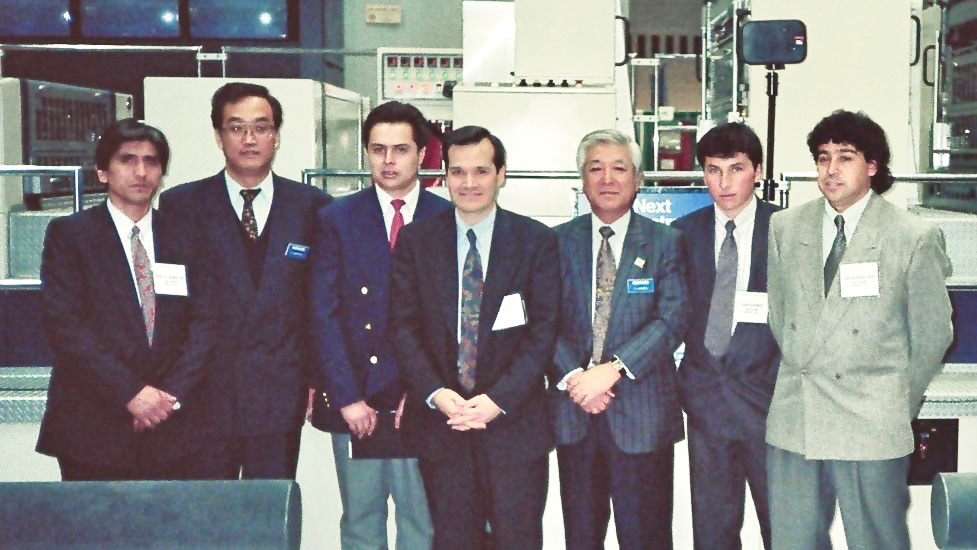
Meeting at Graph Expo in Chicago with top Komori management.
L to R: Cesar Villalobos, CEO, Satoshi Mochida, Cristian Castro, Chairman Yoshiharu Komori, Oscar Guerrero and Jose Valenzuela.
Visual Engagement Revolution: We displayed all production metrics prominently throughout the facility, allowing operators to view real-time performance data. This transparency transformed operator engagement like never before—workers began actively discussing the graphs, analyzing trends, and taking ownership of the improvement process in ways management had never witnessed.
Ambassador Development: Workers who had never seen operations outside their facility returned as ambassadors of excellence, sharing knowledge and driving continuous improvement throughout the plant.
This combination of clear technical standards, personal recognition, visual performance transparency, and exposure to industry best practices created unstoppable momentum for change.
For effective workforce development, it is best to avoid using technical jargon and instead focus on concepts that workers already understand from managing their own lives and resources. People naturally comprehend ideas such as creating value, eliminating waste, and continuous improvement, as these concepts are familiar and widely understood.
Avoid Lean Jargon: Rather than overwhelming workers with technical terminology, we focused on practical concepts they could immediately apply.
Natural Understanding: We successfully introduced 5S, standardized work procedures, Kaizen, PDCA, SMED, and root cause analysis by connecting them to everyday decision-making processes.
Genuine Buy-in: This approach created authentic ownership of the improvement process rather than mere compliance with management directives.
The biggest mistake in modern manufacturing is treating technology as the primary solution to operational problems. Digital tools and automation are powerful enablers that amplify both effective and wasteful existing processes.
.
The most successful implementations combine technology with solid fundamentals and empowered operators who understand their purpose and can act on the provided information.
Once fundamental capabilities are established, intelligent production planning becomes the critical breakthrough for optimizing throughput and streamlining the complete workflow from customer order to finished product. This is where InSoft Automation transforms manufacturing operations from reactive to predictive.
The Throughput Revolution: InSoft Automation represents the key technological advancement that bridges the gap between lean fundamentals and competitive manufacturing excellence. Their comprehensive planning solutions don't just optimize individual processes—they revolutionize entire workflows by intelligently connecting every step from initial customer order through final product delivery.
Insoft Automation's ganging solution reduces setup times by over 40% and waste by 30%.
End-to-End Workflow Integration: Traditional production planning treats each stage independently, creating bottlenecks and inefficiencies throughout the workflow. InSoft Automation's integrated approach optimizes the entire process flow, ensuring that customer orders are translated seamlessly into optimized production schedules that maximize both throughput and resource utilization.
The Manual Planning Bottleneck Eliminated: Where traditional production planners face complex challenges arranging multiple jobs while balancing material utilization, production efficiency, and delivery schedules, InSoft Automation's systems analyze incoming orders in real-time and automatically arrange jobs for optimal results. What previously required hours of manual planning now occurs in minutes, yielding consistently superior outcomes.
Strategic Competitive Advantage: The InSoft Automation difference extends far beyond operational efficiency. Their systems enable manufacturers to accept more complex orders, guarantee shorter lead times, and maintain consistent quality—all while optimizing resource utilization. This creates sustainable competitive advantages that competitors using manual planning cannot match.
Strategic Transformation Results: Facilities that implement InSoft Automation solutions achieve comprehensive operational improvements, creating sustainable competitive advantages that manual planning cannot match.
InSoft Automation provides the foundation for scaling operations without increasing planning complexity.
The Scalability Factor: As order volumes grow and product mixes become more complex, their automated systems maintain efficiency levels impossible to achieve through manual methods, making them essential for long-term competitive sustainability.
Vistaprint deserves recognition for fundamentally transforming printing from a craft-based operation to a systematic manufacturing process. Their approach demonstrates how intelligent automation, when properly integrated, can revolutionize entire industries.
Comprehensive Digital Foundation: The company's success stemmed from proprietary software created by a Ph.D. Senior Lead Software Engineer Jay T. Moody, whose vision encompassed paperless manufacturing processes with capabilities to monetize every activity.
Waste Monetization: Most significantly, this digital transformation enabled the ability to monetize waste and implement corrective measures with unprecedented accuracy. What traditional manufacturing viewed as unavoidable losses, Moody's system could track, analyze, and often convert into profitable opportunities.
Vistaprint demonstrated that even highly customized products could be manufactured with the same efficiency and reliability as traditional manufacturing.
Production Integration: The business model's instant success was supported by lean manufacturing principles, which utilized ganging production layouts on fully automated Manroland sheet-fed presses and digital HP Indigo presses.
Industry Transformation: By standardizing processes, implementing predictable workflows, and leveraging data-driven production planning, Vistaprint demonstrated that even highly customized products could be manufactured with the same efficiency and reliability as traditional manufacturing.
The lean manufacturing evolution that Keane championed has proven enduring. Today, Vistaprint is part of Cimpress and continues to lead the industry in mass customization. This is a direct result of building foundational understanding of end-to-end workflows within flatter, more responsive organizational structures.
Current State Analysis: Begin with an honest assessment of existing capabilities, identifying gaps in operational fundamentals, workforce development, and technology integration.
Baseline Measurement: Implement simple tracking systems, such as six-minute downtime monitoring, to establish current performance and identify opportunities for improvement.
Pilot Area Selection: Choose one production area for initial implementation, focusing on achieving measurable improvements before expanding to other places.
Standardization Implementation: Develop and document optimized procedures for setup, maintenance, and quality control processes to ensure consistency and efficiency.
Workforce Empowerment: Eliminate unnecessary approval layers while providing operators with clear objectives and decision-making authority.
Basic Technology Integration: Implement simple automation and tracking systems that enhance rather than replace human capabilities.
Intelligent Planning Systems: Deploy automated ganging and optimization tools once fundamental processes are stable and standardized.
Continuous Improvement Culture: Establish systems for ongoing capability development and adaptation to changing conditions.
Organizational Resilience: Build financial flexibility, supplier diversity, and adaptive capacity that enables thriving under pressure.
Traditional financial analysis fails to capture resilience value because it measures return on current operations rather than protection against future disruptions. The true ROI becomes clear only during a crisis, when prepared companies continue operating while competitors struggle.
The Mathematics of Prevention: Equipment failure prevention through predictive maintenance ($2,000 annually) versus failure costs ($10,000 in lost production). Supply chain diversification (5% additional material costs) versus disruption losses ($500,000 for week-long downtime). The numbers strongly favour proactive investment.
Hidden Cost Revelation: Systematic measurement revealed costs that traditional accounting methods overlooked—equipment failures following predictable patterns, setup delays accumulating into significant losses, and material shortages revealing systemic procurement weaknesses.
Compound Investment Returns: Resilience investments yield compound benefits through reduced downtime, improved quality, enhanced flexibility, and competitive advantages during industry disruptions, which far exceed the initial costs.
Conservative Risk Management: Resilient manufacturers maintain financial flexibility through conservative debt levels and diversified revenue streams, enabling investment in capabilities during stable periods.
Environmental Alignment: Sustainability initiatives typically align with operational efficiency, creating double benefits. Reducing material waste saves money while helping to meet environmental goals. Energy efficiency programs reduce operating costs while lowering carbon footprints.
Strategic Positioning: Early adopters of best practices often find themselves ahead of competitors when new regulations or market conditions favour their capabilities.
Recent supply chain disruptions exposed fundamental weaknesses in manufacturing strategy. Companies that maintained diversified supplier bases and regional sourcing options weathered disruptions far better than those optimized purely for cost.
Total Value Evaluation: Innovative manufacturers now evaluate suppliers based on delivery reliability, quality consistency, financial stability, and geographic diversity—not just cost. The slight premium typically pays for itself during the first supply disruption.
Regional Relationship Value: Local sourcing reduces transportation costs and delivery times, while providing greater flexibility and improved communication. Regional suppliers often invest more in relationship-building since they can't easily replace business with distant alternatives.
Environmental improvements typically align with operational efficiency, creating strategic advantages rather than cost burdens.
Circular Economy Principles: The Chilean packaging company pioneered circular economy approaches decades before they became fashionable—not solely for environmental reasons, but because raw material costs significantly impacted profitability.
Early Adoption Benefits: Today's manufacturers can create competitive advantages through environmental leadership, as customers increasingly prefer suppliers with strong sustainability credentials, and regulatory requirements continue to expand.
Production Planning Integration: Intelligent systems contribute to environmental goals by maximizing material utilization and minimizing waste, demonstrating how operational efficiency and environmental responsibility mutually reinforce one another.
The most resilient manufacturers share characteristics that extend beyond operational efficiency:
Financial Discipline: Conservative debt levels and diversified revenue streams that provide flexibility during uncertain periods.
Continuous Learning: Ongoing investment in workforce development that creates internal capabilities for adaptation and improvement.
Relationship Focus: Supplier relationships based on mutual benefit rather than purely transactional terms.
Adaptive Culture: Organizational cultures that embrace change as opportunity rather than threat—often the determining factor between success and failure.
Responsive Structure: Flatter organizational structures enable rapid decision-making and immediate problem-solving at the operational level.
Manufacturing resilience isn't built through single initiatives or isolated improvements. It emerges from consistent attention to fundamentals: operational excellence, workforce development, supplier relationships, financial discipline, and environmental responsibility.
Foundation-First Approach: Master the basics of waste elimination, quality control, and workforce engagement before pursuing advanced techniques. Build these capabilities into organizational habits that persist through leadership changes and market fluctuations.
Technology Leverage: Utilize intelligent automation tools to amplify the impact of solid fundamentals, rather than replace them. When combined with standardized processes and engaged operators, these technologies deliver transformational improvements.
Adaptive Preparation: The manufacturing landscape will continue evolving with new challenges and opportunities. Organizations that build adaptable capabilities today position themselves for success, regardless of future disruptions.
Continuous Evolution: Resilience isn't a destination—it's an ongoing process of preparation, adaptation, and improvement that becomes a sustainable competitive advantage.
The companies thriving today started building these capabilities years ago, often during stable periods when change seemed unnecessary. They understood that resilience requires investment before a crisis, not reactive measures after problems emerge. For manufacturers embarking on this journey, the key is to start with solid fundamentals and build systematically toward comprehensive capability, rather than chasing the latest trends or quick fixes.
The facility's outstanding productivity in Chile attracted the attention of regional printers who wanted to replicate its success. In 1995, the director and owner received the Conlatingraph "Man of the Year" award, with his name displayed on the Eagle bust at PAF headquarters in Orlando. The GALA award recognizes excellence in the industry and fosters inter-American connections.
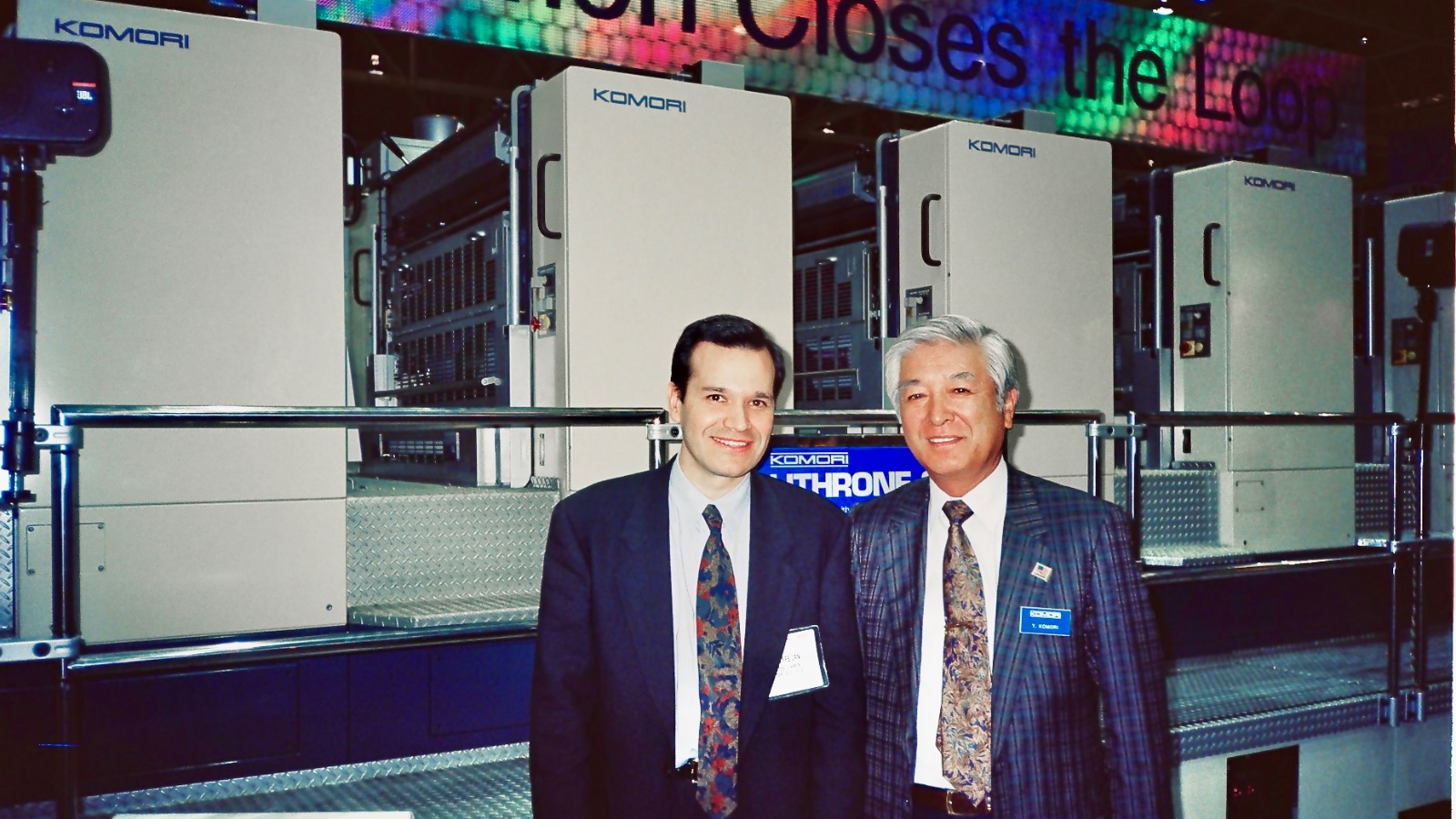
That same year, the Regional Komori dealer invited Jan Sierpe to join Brazil's top ten printers on a tour of various facilities in the United States. During this tour, he shared his expertise on machine configuration, lean strategies, and measuring downtime at their operations.
_______________________________
Jan Sierpe is a global press instructor and print media specialist with over 30 years of experience in the Americas, Europe, and the Middle East. He specializes in continuous improvement, process optimization, and waste reduction in areas such as security printing, packaging, labels, and commercial printing. As a contributing writer for Inkish in Denmark, Jan analyzes trends in the printing industry, and his insights are published in multiple languages across international trade publications.

Proofed (Human)

Listen to This Article

Loading...

Login
New User? Signup
Reset Password
Signup
Existing User? Login here
Login here
Reset Password
Please enter your registered email address. You will recieve a link to reset your password via email.
New User? Signup
Currency Exchange Graph