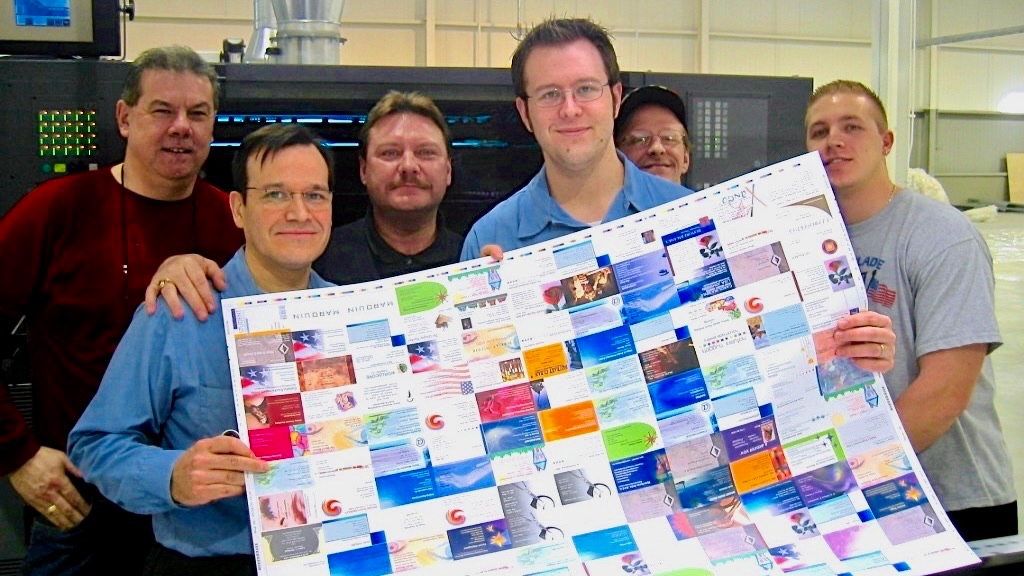
VistaPrint Windsor Plant - First printed Sheet 2005
Dan Gelbart's journey from immigrant engineer to printing industry revolutionary exemplifies how transformational innovation emerges from deep technical understanding combined with economic pragmatism. Born in Germany in 1947, raised in Israel, and immigrating to Canada in 1973, Gelbart brought a unique perspective to an industry ready for fundamental change.
After completing his electrical engineering degree at the Technion Israel Institute of Technology and gaining experience with satellite imagery systems at MacDonald Dettwiler and Associates, Gelbart co-founded Creo Products in 1984 with a radical proposition: to eliminate film from the printing process while fundamentally restructuring workflow economics.
The evolution from concept to industry standard occurred with breathtaking speed. When Kodak introduced the Approval system at DRUPA 1990, it demonstrated laser thermal imaging capabilities, but it was Gelbart's engineering approach that made commercial application viable.
At a TAGA presentation, Gelbart explained his economic engineering philosophy with characteristic clarity. Traditional drum-based systems positioned laser heads at centers, requiring enormous energy to maintain imaging precision across variable distances as plates rotated. His insight was elegantly simple: position the laser close to the plate wrapped around a cylinder, minimizing energy requirements while maximizing accuracy. This wasn't technical optimization—it was economic engineering that made thermal CTP commercially viable.
Between 1991 and 1994, intensive development at Creo transformed this concept into a production reality. The breakthrough came through understanding that workflow integration was as crucial as imaging technology. While the industry focused on eliminating film, Gelbart envisioned eliminating departmental barriers between prepress and pressroom operations.
The market probe installation at Quad/Graphics in Hartford, Wisconsin, in 1994 proved the concept under real production conditions, demonstrating how integrated workflows could transform operational economics throughout the printing process. By 1995, Creo positioned itself against industry giants, presenting a complete process transformation while competitors offered incremental improvements.
Attending these DRUPA exhibitions alongside my friend Erwin Widmer, the distinguished former Managing Director of Ugra in St. Gallen (who would later receive the prestigious TAGA Michael H. Bruno Award in 2015), I witnessed firsthand the industry's initial skepticism. More CTP systems appeared on display than actually existed worldwide. However, the partnership with Kodak Polychrome Graphics provided the crucial chemical foundation, and the commercial availability of thermal plates in January 1996 triggered exponential growth.
Large-scale validation was achieved through beta installations at major operations, including R.R. Donnelley and Rand McNally. Between 1997 and 1999, thermal technology gained unstoppable momentum as Kodak scaled production globally to meet demand.
At DRUPA 2000, I attended the TAGA technical sessions in 1999, exactly one year before the exhibition, where Gelbart presented his engineering philosophy. I learned that economics drove every design decision he made. The energy efficiency of his close-proximity laser approach was not only a matter of technical elegance; it was a crucial factor in reducing costs and making the entire computer-to-plate (CTP) revolution economically viable. By 2000, approximately 2,000 thermal installations represented a complete transformation of the industry, with Creo's acquisition of Scitex's digital prepress division solidifying its market dominance.
Gelbart's TAGA presentation revealed the economic thinking behind his technical decisions. The energy efficiency of close-proximity laser imaging wasn't just an engineering optimization—it was a fundamental cost reduction that made thermal CTP competitive with traditional film-based processes.
In later correspondence, Gelbart shared his perspective on innovation: "I have an interest in precision mechanics, optics and electronics." This multidisciplinary approach enabled him to see solutions that specialists in single fields might miss. He also reflected on Creo's market success, noting, "As you pointed out, the main reason for the success of Creo was shifting the industry from photonic imaging (UV or violet) to thermal imaging, which has huge advantages."
Traditional drum-based systems required powerful lasers to maintain imaging quality across variable distances as plates rotated. Gelbart's cylinder-based approach minimized this energy requirement while improving imaging precision. The economic advantage compounded: lower energy costs, reduced laser complexity, improved reliability, and simplified maintenance requirements.
This engineering philosophy extended beyond the platesetter itself. Gelbart recognized that true transformation required rethinking the entire workflow, not just replacing one process step with another. His vision encompassed plate production as an integrated part of the press operation, rather than a separate departmental function.
While the printing industry adopted thermal CTP technology within existing departmental structures, Vistaprint represented the complete realization of Gelbart's revolutionary vision. My implementation work at their Windsor, Ontario, plant, under the guidance of COO Dries Eefting, revealed how true workflow integration could function in practice.
Eefting challenged us to eliminate press-side register adjustments through superior platemaking accuracy. Collaborating with Samuel Gilad from Creo, we achieved a breakthrough: calibrating the platesetter to deliver consistent precision within 0.05-0.10 mm, below the threshold of human visual detection. This 42-micron tolerance, approximately one-quarter of a 150 LPI halftone dot at 50% coverage, accommodated cumulative mechanical variations across multicolour printing units while remaining imperceptible to viewers.
The results validated Gelbart's vision completely. We achieved a 95% success rate, with the Manroland APL system transforming what had been skilled, manual operations into predictable, automated upstream processes. Although we explored implementing FM screening to leverage this precision further, Vistaprint chose to optimize its proven AM workflow rather than introduce additional variables. Register precision, which once required press operator intervention, became a manufacturing certainty.
The success stemmed from the perfect alignment of multiple factors. Vistaprint's digital-native culture eliminated legacy departmental silos, its on-demand business model matched the economics of integrated plate production, and their Manroland presses embodied automation principles from inception. This convergence made Gelbart's platesetter-next-to-press concept not just feasible, but inevitable.
The limited industry adoption of integrated workflows reflected organizational challenges rather than technical limitations. Traditional printing companies faced substantial barriers: established departmental structures, union agreements, and skill hierarchies that made workflow integration complex. For many companies, film elimination alone provided sufficient return on investment, reducing motivation for further organizational change.
Perhaps most significantly, Gelbart's complete vision required cross-training press operators in prepress skills and vice versa—a substantial investment many companies avoided. The industry embraced eliminating film but hesitated to eliminate departmental boundaries.
Dan Gelbart's contribution to printing technology represents more than technical innovation—it demonstrates how visionary engineering can fundamentally transform industry practices. His approach of solving economic problems through elegant technical solutions created a lasting impact that extends well beyond the printing industry.
With over 100 patents to his name and a successful transition to medical technology and metal 3D printing following the sale of Creo to Kodak, Gelbart demonstrated that fundamental engineering principles are applicable across various industries. His emphasis on economic efficiency driving technical design remains a model for innovation in any field.
The Computer-to-Plate revolution validates how successful transformation requires both technical breakthrough and implementation vision. While thermal CTP became universally adopted, the complete workflow integration Gelbart envisioned—successfully demonstrated at Vistaprint—remains a road less travelled.
His legacy reminds us that true innovation often requires looking beyond immediate technical challenges to envision how entire systems can be reimagined for maximum effectiveness. The speed of transformation from DRUPA's 1990s proof-of-concept to its 2000s market dominance demonstrates how quickly industries can evolve when economic necessity meets elegant engineering solutions.
Dan Gelbart's vision of integrated workflows and his principle that economics should drive engineering design continue to influence how we approach technological transformation in printing and beyond.
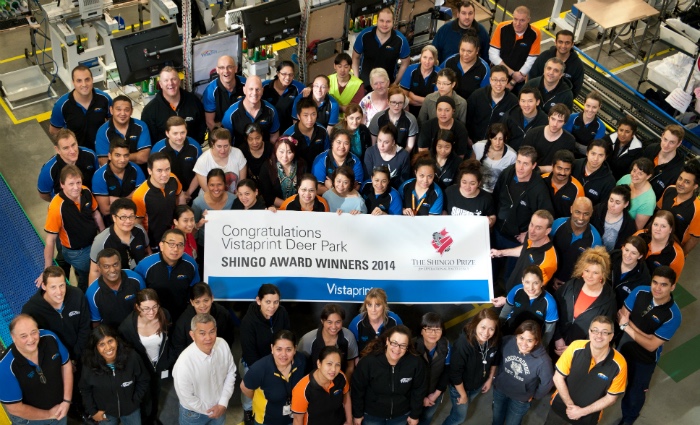
Vistaprint Deer Park Australia - Shingo Bronze Medallion 2014
____________________
About the author: Jan Sierpe is a global press instructor and print media specialist with over 35 years of experience in the Americas, Europe, and the Middle East. As a contributing writer for Inkish in Denmark, Jan analyzes trends in the printing industry. His technical insights are published in multiple languages in various international trade publications. He specializes in continuous improvement, process optimization, and waste reduction in various areas, including security printing, packaging, labels, newspapers, large-format inkjet printing, and commercial printing. Jan Sierpe | 416 697 8814 | sierpe.jan@gmail.com

Proofed (Human)

Listen to This Article

Loading...

Login
New User? Signup
Reset Password
Signup
Existing User? Login here
Login here
Reset Password
Please enter your registered email address. You will recieve a link to reset your password via email.
New User? Signup
Currency Exchange Graph