Product packaging designs often create visual expectations and establish immediate associations with the perceived quality of the products.
However, some packaging designs may not be as relevant as the actual quality of the product itself. The product's taste can often evoke an emotional experience that surpasses customer expectations.
We will examine the idea that certain products are accepted as they are, with imperfections being part of the brand's exotic appeal.
For over 130 years, Heinz has been producing and selling ketchup inspired by a Chinese recipe. The brand reaches households across the USA and Canada, selling more than 650 million bottles annually, which amounts to approximately 1.5 billion dollars in sales worldwide.
Additionally, Heinz distributes 11 billion single-serve ketchup packets globally each year. During the pandemic, executives addressed concerns about shortages of these packets. The Wall Street Journal reported on the increased demand from restaurants during this time, and demand has remained high ever since.
Despite being considered a true American product, Henry J. Heinz has been a significant part of American culture for over a century. However, many people may not realize that the tomatoes used by Heinz are harvested in Leamington, Ontario, by seasonal workers from Mexico, including members of the Mexican Mennonite community.
Following the temporary closure of the processing facility in Leamington, Ontario, in 2014, Heinz resumed ketchup production in Mont-Royal, Quebec, much to the delight of Canadians.
So, Heinz ketchup remains a Canadian product. How would this be affected by the new tariffs imposed by Mr. Trump?
According to CBC, U.S. tariffs mainly target imports. Because Heinz ketchup made in Canada, even though it is produced by a U.S.-based company, is classified as a Canadian product, it is not subject to these tariffs.
Many consumers wonder if the colour of Heinz ketchup is natural. The company claims its ketchup contains no artificial additives and uses only heirloom strains or hand-picked ripe tomatoes.
However, the red colour of Heinz ketchup is not entirely natural. While ripe tomatoes contribute to a natural red hue, Heinz ketchup also contains added food colouring to achieve its Brand signature bright red colour.
Red Dye 40 is reported to enhance the colour of ketchup, an artificial substance commonly used to add red colour to foods, drinks, and other products. The Food and Drug Administration (FDA) certifies Red Dye 40 as a safe food additive.
Heinz pays close attention to the red colour of its ketchup, the traditional bottle shape, and the labels, believing these elements are critical to the product's success.
Similarly, Tabasco, made in Avery Island, Louisiana, also focuses on presentation
Tajín has carved out a unique niche in the food industry by popularizing chili-lime seasoning for a diverse array of foods, including fruits, vegetables, and snacks. The brand has experienced significant growth, driven by social media trends and an increasing global appetite for these flavours.
Tajín features a distinctive blend of mild chilli peppers, sea salt, and dehydrated lime. Research indicates that 80% of people who try Tajín with fruits and vegetables enjoy the flavour and often experiment with different food pairings.
Tajín has formed strategic partnerships with several companies, including Stemilt, Borton Fruit, Del Monte Fresh, Chelan Fresh, the Chilean Fruit Association, the National Mango Board, the National Watermelon Promotion Board, Pear Bureau Northwest, Farmington Fresh, Dole, Stone Ridge Orchards, the Washington State Fruit Commission, Giumarra, the US Apple Association, World Food Products, and Taylor Farms.
Tajín seasoning, an imported spice blend, may be affected by US tariffs. Tariffs and taxes on imported goods can increase consumer prices as the costs of importing and distributing the products rise. Since Tajín is a popular spice mix, any tariffs on its ingredients or the finished product could lead to higher prices at grocery stores, potentially affecting demand.
This Mexican product, which expanded rapidly in the US and Canada, has proven that presentation is not always essential; it has captured consumers' attention and their desire for exotic flavours.
While Tajín operates on a smaller scale than Kraft Heinz, its rapid growth trajectory highlights its increasing influence in the seasoning market.
2024 Sales Growth of Tajin +109% (from $55M to $115M)
2024 Sales Growth of Kraft Heinz -3.0% (from $26.64B to $25.85B)
Created in Mexico, Tajín was introduced to the US nearly 40 years ago and is now available at Walmart, Costco, and Amazon. It can be used with a variety of foods, from eggs and salads to fruits, and it enhances the flavours of grilled fish, meats, and chicken wings. It's a natural seasoning, free of MSG, and adds a delightful kick to guacamole or grilled corn. This powder seasoning is expected to stay very popular this summer despite the price increases.
Tajín and Heinz are not directly competing products. Tajín is a seasoning blend made from chilli and lime, while Heinz is a company known for its extensive range of food products, including ketchup, condiments, and various canned goods. Tajín competes with other spice blends and flavour enhancers rather than specific Heinz products.
Tajín is a versatile seasoning that can rim glasses for Bloody Marys’ or Micheladas or enhance margaritas, whether spicy or mild. True aficionados often sprinkle it on popcorn, considering it a game-changer.
What is the secret behind this Mexican spice, created by Horacio Fernandez Castillo, that has captured the imagination of so many people?
As the story goes, Tajín was created by Fernandez's grandmother, "Mama Necha," as a sauce. He wanted to recreate the sauce in powder form to market it as a sprinkle spice on foods and claims to be the first in the world to develop a secret process to dehydrate the chilis and limes.
After visiting with his family the pre-Columbian archaeological site El Tajín in Veracruz, Fernandez named his product after it. The company, officially called Empresas Tajín, is in Zapopan, Jalisco, which is also the state where authentic Tequila comes from.

Forbes recognized this Mexican business miracle valued at 1.5 billion US dollars and coined a new term for wealth and its founder: a Chili-Onaire.
I recommend reading Forbes staff writer Chloe Sorvino’s article about the founder of Tajin.
https://www.forbes.com/sites/chloesorvino/2025/02/21/fresh-take-for-this-successful-food-entrepreneur-its-all-about-the-spice/
Also, for those interested in learning more about it watch Forbes video post to understand Tajin's business scope better. https://youtu.be/vmH2PZf8r9s?si=ANComF6aasOn2yBL
Numerous marketing studies indicate that packaging plays a significant role in shaping customer expectations for product brands. However, this does not apply to Tajín; consumers drawn to its flavour appear indifferent to the packaging.
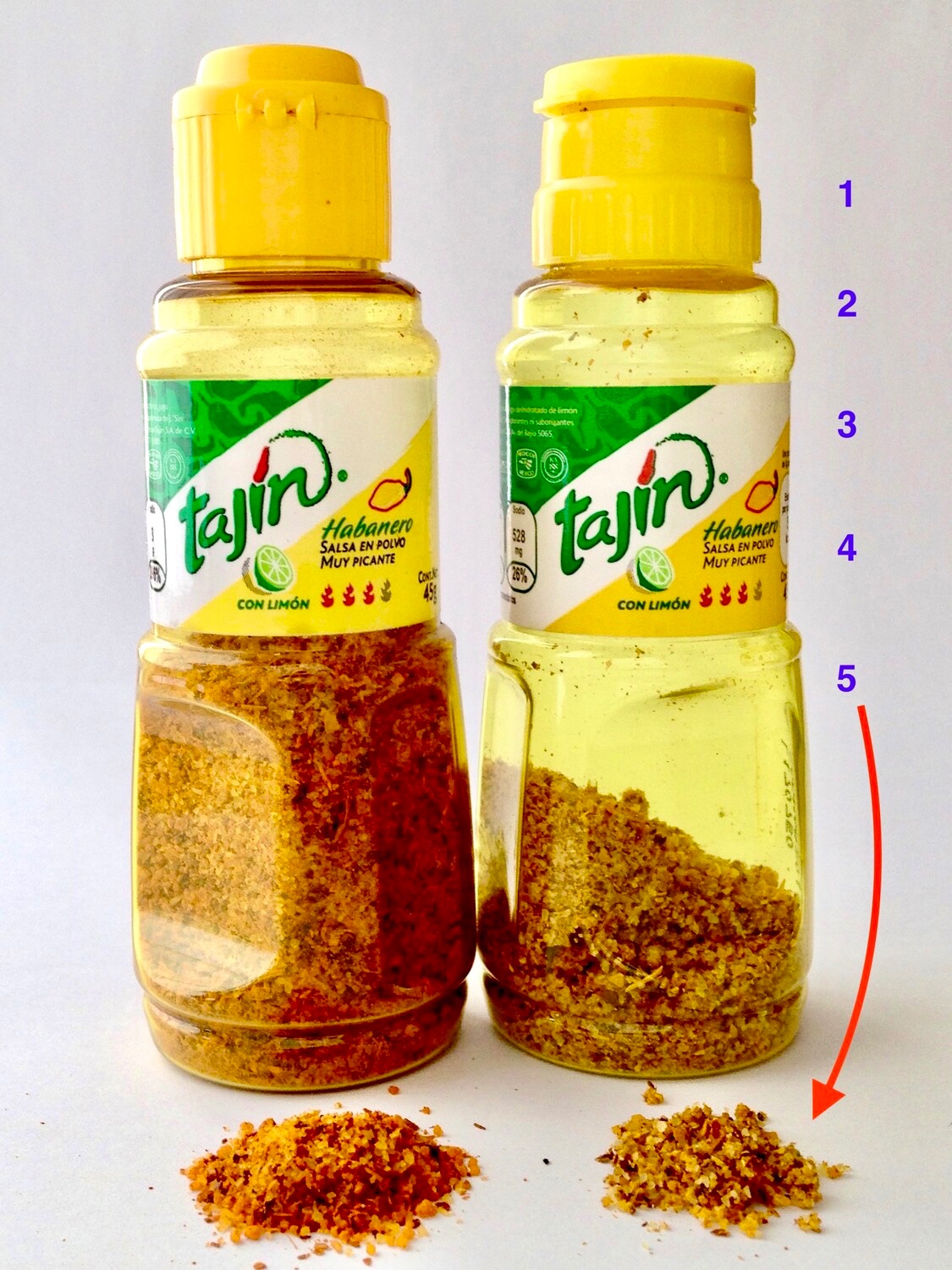
In the image below, you can see two randomly selected bottles from supermarkets in Mexico that showcase different packaging designs style for unknown reasons. Despite these variations, the company's sales continue to experience remarkable growth.
For Tajín, packaging may not be as important as the product's taste. Even with differing colours and designs, customers remain strongly connected to the authentic flavours of the product.
My hope is that this article reaches Mr. Trump and makes him realize that touching the endless appetite for Mexican flavour might not appeal to his support base. I hope he will reconsider and exempt tariffs on this product.
1- Cap Style, colour and seal differences
2- The Colour bottle is slightly different.
3- Label designs Dark Green, Yellow and Red are different shades.
4- Label alignment with the bottle.
5- Product colour, coarse granular shape differences.book.
About the Author - Jan Sierpe is an Inkish collaborator who advocates for technical innovations to reduce waste and increase productivity in the graphic arts industry.
Throughout his career, he has focused on introducing lean principles to printing operations, commissioning Manroland and Heidelberg printing presses, process optimization, and training press operators.
In addition, he is a minimalist and has written several articles highlighting Dieter Rams's brilliance and his 10 Principles of Good Design. These principles have influenced designers long before the rise of the Internet and continue to impact our lives today significantly.

With award winner filmmaker Gary Hustwit, known for his documentaries Documentary , Objectified and Urbanized, introduced viewers with RAMS to an intimate portrait of a man who enjoys a private life in one of the busiest cities in Germany, which influenced the design world. Talking with Gary Hustwit at the Canadian Premiere Screening of "Rams" (Sep 26, 2018).




Login
New User? Signup
Reset Password
Signup
Existing User? Login here
Login here
Reset Password
Please enter your registered email address. You will recieve a link to reset your password via email.
New User? Signup
Currency Exchange Graph