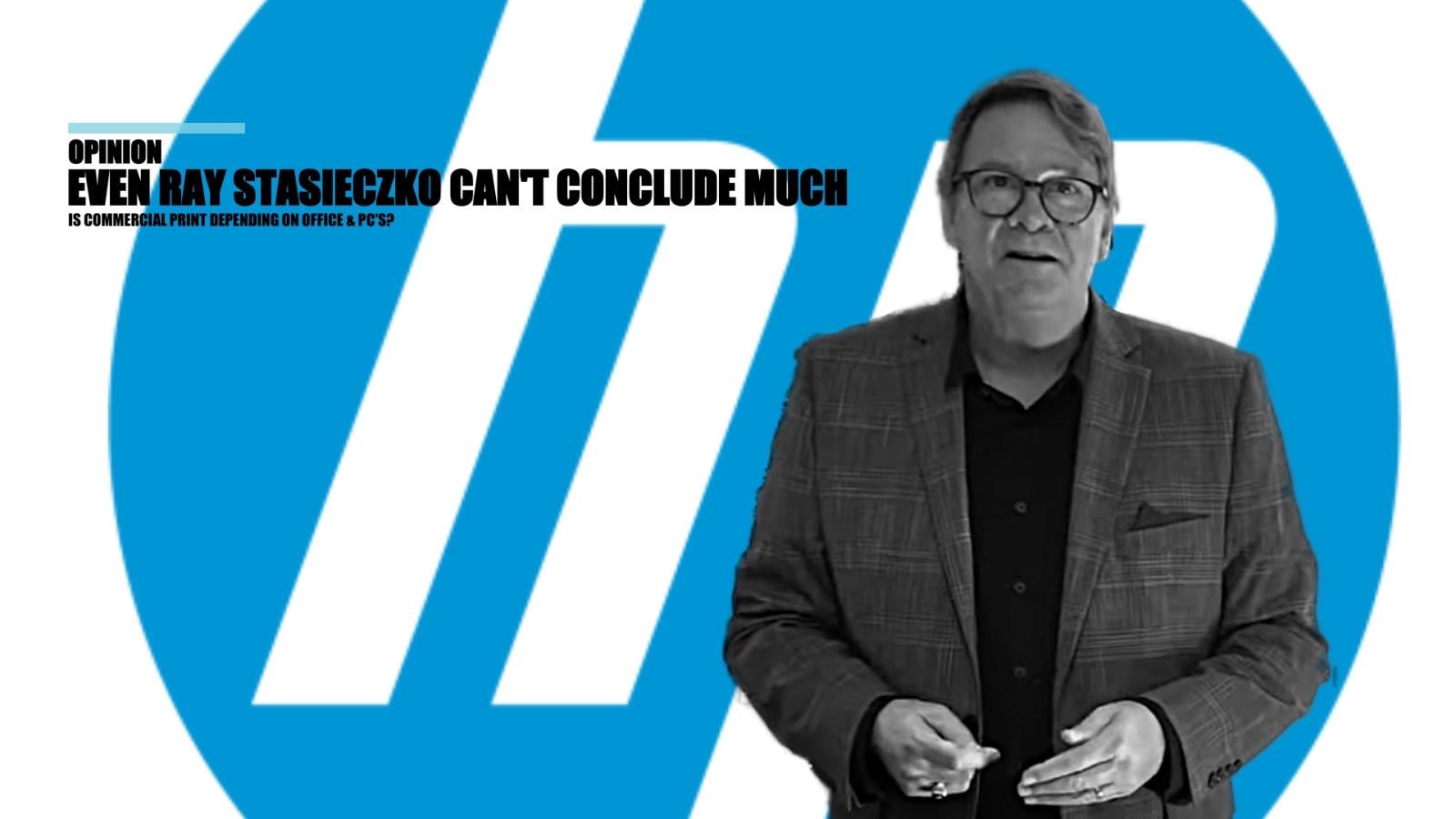
The End of Day with Ray is one of the print channels I like to follow. I follow it because I like the straightforward way Ray Stasieczko addresses companies, topics, the industry, and issues that are important to him. Though I don't know much about the office segment, I still find it interesting as he also, in that perspective, talks about the big OEMs like HP, Konica-Minolta, Xerox, and others, that also have arms in the Segment I work in, and believe I know something about!
Last week, he chose to talk about drupa - a tradeshow he probably has never attended and an industry segment he clearly doesn't know anything about, and that made me want to comment on his 'The end of the Day with Ray,' as I believe he, first of all, jeopardizes the graphics arts industry and said doesn't know what he is talking about!
When you analyze without facts, it's just an opinion, precisely what happened in that episode! One of the challenges in analyzing annual reports and fiscal data, which also Ray Stasieczko has talked about, is when data hasn't been detailed. As HP, for example, is a public company, everybody should have access to the same data at the same time, and when Ray Stasieczko, in the episode, harasses me, other industry reporters, and analysts for not reading the numbers, this is not true.Morten B. Reitoft, Editor-in-Chief · INKISH

However, after being bashed, the CEO of INKISH, Henrik Klem Lassen (economist and external professor), and I looked a bit deeper into the numbers from HP to see if we have missed anything - and the conclusion - just as Ray Stacieszko earlier said - the data isn't there. HP does not provide precise data to conclude whether the Commercial (Graphic Arts and Industrial print) is significantly subsidized by the other parts of the HP business. It's impossible to look at the Supplies/consumables and conclude which of the two print parts is the major contributor to the overall business. There are NO notes or writings sharing that information in the annual report. So dear Ray - neither of us can conclude on that matter!
When Ray Stasieczko suggests that commercial print isn't a big business in revenue and contribution, that is not a simple question to answer based on the publically available data. The quarterly and annual reports are divided into printing, Personal Systems, and Corporate Investments/others. Printing consists of both office print and commercial print, and you can't, with the data provided, specify the direct size of commercial print over office print. Another thing is that out of HP's $4.3 billion revenue in Q3 (for example), 65% is supplies, which covers both commercial and office print - and here it starts to be interesting.
Over the past seven quarters, unit sales and revenue on commercial print (in the notes) either decreased less than office print or delivered up to five percent net growth and yes, this is not impressive. Still, as both T-series and Indigo printers deliver considerable volume, this must influence the Supplies or consumable business. I can't know, but neither can Ray Stacieszko, as these numbers are NOT delivered to the public. But one T-series printer produce millions of print per month, and no office printer is even close to this number, so even though the quantity of sold units is lower, the volume of each printer is WAY higher. You can argue that the price for consumables in the volume business may be lower than in the office segment. Still, I counter that, as HP owns most of its Commercial distribution and doesn't have to deliver margins to resellers, retailers, consultants, or whoever sells the office equipment!We have written to HP's Investors Relation and asked if they share this data - but even after almost a week, they have not answered ANYTHING. That is a concern worth another article, as HP should be interested in answering media, investors, and potential investors! NOT GOOD!
Adding to the value of sales. All HP commercial printers are expensive; they account for sometimes even thousands of consumer printers in unit sales. When Ray Stacieszko talks about inkjet as a negative for HP - as they live of service - this is not something you can read out of the annual reports - and it also shows that he doesn't know the business. My claim - and this is as much an analysis as what Ray Stacieszko is saying, is that NO official numbers are backing it, so here we go. A few years ago, HP reorganized its commercial print business into one division called Industrial Print.
HP has several products under the Industrial Print division - the two most dominant product lines are HP Indigo (from Israel) and Inkjet T-series (from USA.) These two product lines do not cannibalize much, as Ray Stacieszko claims - they complement each other. That is, however, changing, and I believe that's why HP has now grouped these products under the Industrial Print banner. What is more interesting is that the T-series, with its speed and quality, is not replacing toner but offset. This is essentially an opportunity for HP and its nearest competitors (which in this case isn't Konica-Minolta or Xerox, but Canon and Ricoh) as hundreds of thousands of printers globally over the next decade will need to change from analog to digital printing equipment - and though you believe that print is dying, it's not true. Several segments in printing are growing - books as one example.
Printing in an office environment is most likely decreasing, as Ray Stacieszko claims - I agree - emails are smarter, better, faster, cheaper, and all the other good reasons. The difference between an office and a print business is that the printing device in a Commercial Printing Company is merely a tool to make money - so printing may not be what it used to be, but printing today is textile, decor, books, outdoor, and electronics - in short, what we refer to as 'New Print.'
If customers stop demanding printed sheets in a brochure, collateral, business cards, or what-so-ever, the printers that understand the future will invest in technologies that serve the customer's new needs. Do you think hundreds of thousands of printers stare at the screen and wait for death?
Print is NOT dead, but print is changing.
HP's position in the professional or commercial market is strong. They have Indigo's in many different sizes and price ranges (16000 installations according to themselves), T-series inkjet printers for volume, and then they have products that neither Konica-Minolta nor Xerox have - wide format printers, textile printers, 3D printers, and very strong in flexible packaging, folding cartons, and even corrugated. HP also has powerful production- and workflow software, which Xerox has, but Konica-Minolta less!
As you may think that Carl Icahn and his plan to do a hostile takeover of HP was a good idea, the printing industry held its breath, and many said publicly that if Icahn's mission had succeeded, they wouldn't be interested in being HP customers anymore.Xerox has been a tremendous powerhouse when it comes to inventions. One of the holders of most patents until they donated all their PARC patents, and a production powerhouse, developing and producing printers that are used by thousands of printing companies globally, so downgrading them to dealers only, well - if they become a 'dealer only,' I am certain that the margins they used to have would be so tiny that buyback programs, leasing programs, and colorful click prices will be impossible to do, and who knows, maybe that will make it less attractive and way more challenging to sell Xerox!
When HP took the poison pill and initiated the share buyback program, it was to make hostile takeovers more difficult. Would it be better to invest in R&D and better products - sure - but with HP's equity/debt ratio before Icahn, they were too attractive for so-called activist investors - and you may say it would have been better for shareholders - but I disagree. Long Term, it would have killed both companies. The cultures are, in my mind, not compatible.Icahn wrote in his farewell that he was sad seeing an icon like Xerox fall, but he has never realized that it's because of HIM that Xerox has fallen.
Think of this for a second. If Icahn hadn't invested in Xerox, Xerox and Fujifilm would likely be one company today. With his investment, Icahn stopped a merger, led a hostile takeover, and led Xerox into the worst PRODUCT crisis ever (at least in the Commercial Segment), and people in my Segment keep asking what they will do now?When Ray Stasieczko bashed HP's decision and their promise to shareholders to buy back shares, I think he missed how Xerox was supposed to pay for HP. HP's equity/debt ratio was so low that Icahn essentially agreed with a bank to finance the purchase of HP against security in HP after the sales. When HP took the poison pill, they effectively used the same equity/debt ratio to make themselves less attractive for any hostile takeover - and the result is the same - or even better, if you like HP to be an independent company. I want HP to be an independent company, and I wish that Xerox would return to more glorious times before Icahn destroyed the company and the opportunities Xerox had. Just my personal five cents!
Then - let's move to Xerox and drupa. What you said is NONSENSE. Xerox has no new production printers to show - and even worse - they are getting limited European distribution. Fujifilm, initiated by your friend Icahn, has established the Revoria brand, which, country by country, is competing with Xerox head-to-head.One thousand m2 has a list price of almost €400,000 + stand building, staffing, etc.. Though I agree that drupa and other exhibitions may become obsolete sooner or later, I am confident that the main reason is for the above reasons and not because some smart people at Xerox have decided to go hunting more targeted. If you don't have an organization and you don't have anything new to show - why then spend up to 2 million Euros at an event like drupa - I am confident that THAT is the reason, and not some vision that suddenly made Xerox abandon drupa, and at the same time chose to exhibit at PRINTING United in Atlanta.
I don't believe XEROX is leaving commercial printing. I know dedicated and good people at XEROX who will turn Xerox around and take their share of a market you don't believe exists. In Europe, over 100,000 printing companies and over a million people work in the industry. In the US, you have 70,000+ printing companies. Yes, the ones that can't adapt to a new future will die, but that is, in a nutshell, what capitalism is about - and that is an advantage for the industry, as it will leave space for the companies who adapt to their customers needs - and gee - I have seen SO many printing companies that are SO smart that they won't go away, because YOU don't believe in the commercial side of the industry.Everybody who knows you knows that status quo is the killer, but so is limited knowledge and zero data to back your analysis! Sorry, buddy, but here you are in deep water - and for those who jump to conclusions. Ray Stacieszko has no facts to back his statements about HP's ability to make money from commercial print! That is the killer!
-----
NB. I am not questioning your conclusions on HP in general, but sometimes - just sometimes - the devil is in the details, and though Commercial print is changing, and I agree HP is challenged - there is no reason to jump to wrong conclusions!



Login
New User? Signup
Reset Password
Signup
Existing User? Login here
Login here
Reset Password
Please enter your registered email address. You will recieve a link to reset your password via email.
New User? Signup
Currency Exchange Graph