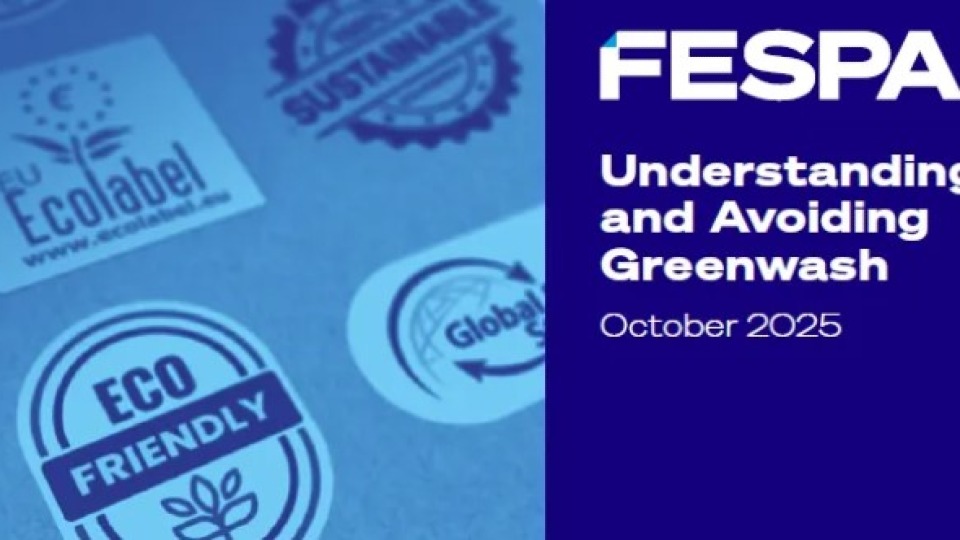
FESPA introduced a new Anti-Greenwashing Sustainability Guide designed to help companies across the print and visual communications sectors navigate an increasingly demanding regulatory environment. Titled Understanding and Avoiding Greenwash, the guide is part of FESPA’s Sustainability Spotlight initiative and is intended to help businesses communicate genuine sustainability progress without creating reputational or legal exposure. The move reflects a market in which sustainability has become a more important buying factor for brands and consumers, while regulators across the UK and EU are taking a harder line on weak or unproven environmental messaging.
One of the guide’s strongest messages is that greenwashing is not limited to claims that are plainly false. FESPA says even technically true statements can still mislead if they omit important context, exaggerate benefits, or ignore impacts elsewhere in a product’s lifecycle, a point that is especially relevant in print, where terms such as biodegradable, compostable, sustainable, and eco-friendly are used too loosely. The guide also highlights the scale of the problem, pointing to research showing that 53% of environmental claims are vague, misleading, or unfounded, while 40% lack evidence, and noting that the EU alone has more than 230 sustainability labels and 100 green energy labels that can add to market confusion.
The guide places strong emphasis on lifecycle thinking, supply chain transparency, and evidence-based communication, warning that even business-to-business print providers may need to supply proof for claims their customers want to make. FESPA also points to upcoming regulatory changes, including the EU’s Directive on Empowering Consumers for the Green Transition, which is expected to tighten standards around substantiation, certification schemes, and carbon-related claims by 2026. For the print industry, the message is clear: broad sustainability language is no longer enough, and the businesses best placed to protect trust will be the ones that can back every green claim with documentation, verification, and a full view of environmental impact.




Login
New User? Signup
Reset Password
Signup
Existing User? Login here
Login here
Reset Password
Please enter your registered email address. You will recieve a link to reset your password via email.
New User? Signup
Currency Exchange Graph