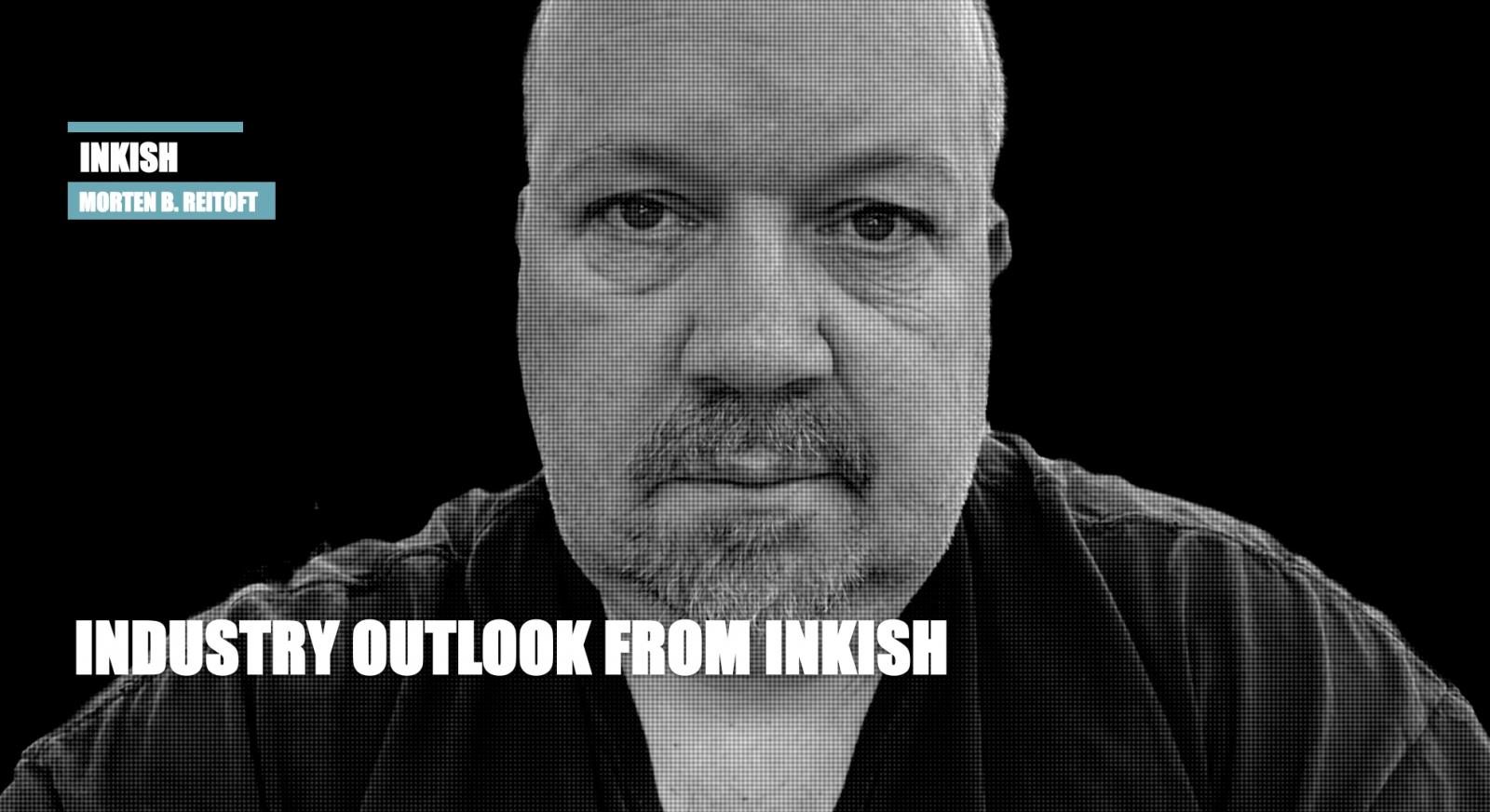
I have, with pleasure, seen the interviews Pat McGrew did with my editor-colleagues Dan Brunton, Tony Curcio, Janet Maitland, Stephanie Gaddin, and Alexia Rizzi. As I have made my predictions for the past five years, I found it an excellent time to do mine now as well.
By Editor Morten B. Reitoft
Why is it at all interesting to predict? First and foremost, we all do it daily. Every time you invest in equipment, people, software, and workflow, you consider the consequences for your company. The more money you tie into an investment, the more critical it is to consider the impact. If you invest wrongly, it can cost your company its life, so predictions from influencers, media, analysts, and colleagues can be valuable add-ons. I say add-on, as when the day is over, it's your call :-)
So when Pat McGrew and my colleagues mentioned above give you an outlook, they give you this with the knowledge and background they have - as this is also the only thing I can promise to do.
I will, however, start somewhere else. Customers. How much we love technology and how much we love the samples and the industry, we are here to serve customers. Customers' needs are defined by business ideas and models and what's possible technically. Some requirements will drive innovation, and innovation will drive demand. Books of one are not new, but it has only become feasible with inkjet, smart binding, software, and the internet.
So what drives innovation? In my previous year's predictions, I have referred to megatrends. Megatrends are defined as global trends not specific to one industry—an example: before I mentioned 'books-of-one.' The overall megatrend for this is the democratization of production, which aims to produce what is only needed, which applies to cars, clothes, books, and food, so a tendency not tied to a specific industry.
In Industry 3.0, we mass-produced goods. In Industry 4.0, we produce what's needed; therefore, productions in all industries work towards serving this particular challenge. In our industry, we see digital print, faster setup of Offset printing machines, binding machines, robots, and innovative software. Companies like Kornit, Landa, Highcon, Twine, and Scodix - to mention a few, work to deliver industry-scale productions of one. All Israeli companies - we will get back to that shortly!
So if we understand megatrends, we also learn about customer behavior and where the future may go! Some of the mega-trends trendings now are the following:
1) Digital Transformation
In 2012 the internet population was 2.12 billion; today, it's 5.07 billion. The average Internet speed in 2012 was 2.8 megabits; in 2022, it was 203 megabits. A service that many uses is LinkedIn. In 2012 174 million people use LinkedIn. In 2022 the number was slightly less than 850 million users. These numbers significantly and directly influence our industry. You can ask, why is this important? Well before the internet was born, we used Yellow Pages and Printed Newspapers, and the role of print was significantly different.
With the above megatrends - the trends themselves are essential to understand how much we need to consider with almost any investment.
So how do the four megatrends mentioned above play a role in our industry?
Digital Transformation is not a unique term and, to many, extremely undefined, but in general terms, it's about adapting new technology into all processes of our companies. It's not only about getting the newest and the latest equipment, which some vendors may tell you. It's mostly about people. Looking at your labor force, you can probably identify at least some challenges - age, education, background, position in your company, how long an employee has been working for you, and many other things. When you segment your staff, you will most likely see that implementing digital transformation requires a lot of motivation, training, etc.
Digital Transformation is also about investing in new equipment. If you think about how your company was ten years ago, what customers you served at the time, and how the market and society were, you get a clearer view of why investing in new technology is complex. It's not about exchanging the same equipment with an update; it's more about identifying future needs.
In the past year, I have written about how the relationship between vendors and PSPs is changing. If you work with a vendor delivering digital print and one that provides analog, I am sure you can identify the difference. The relationship in the future will be more of a partnership. You are already seeing it, as almost all vendors collect production data from your site today. Ten-fifteen years ago, it would be impossible technically, but it would also be business information you would prefer to keep to yourself - and it is controversial. What if YOUR data is used to feed your competitor? What if your data is used as a model for new technology that will give the next generation of equipment a competitive advantage?
Ladies and gentlemen - that happens now, and vendors will be able to utilize all these data even further. They say predictive maintenance. I say predictive behavior, customer patterns, production cycles, etc. AI is part of Digital Transformation, and an effective AI model only needs data to be successful.
But let's take a look at what technology to expect. Before going on with what technology I expect to come, let's take a look at how technology was presented in the Industry 3.0 era. All of the Editors mentioned talk about the importance of tradeshows, and yes. Tradeshows can, for many reasons, still be necessary, but not for product launches. Going to a show to see unannounced equipment is history.
Think about it. A vendor develops and sells equipment. PSPs invest in equipment to support their business. When drupa was canceled in 2020, the vendors still wanted to sell, and the PSPs still wanted to buy, so nobody can accept that a pandemic or a cancelation for whatever reason should halt future business. Almost all vendors have invested in great demo/experience centers with technology that can give customers great presentations, education, etc. So why should a vendor NOT bring their product to market when it's ready, rather than waiting for some exhibition?
And you can see it already? The Ricoh Z75 wasn't presented at a tradeshow? Nor was the HP T-series Advantage 2200, which was even introduced just a few weeks before PRINTING United. Or what about Horizon's BQ500, the Canon IX series, and so forth?
When we covered PRINTING United in Las Vegas earlier this year, I was fueled by all the people and technology. Did I see anything new? Maybe a few things, but not really, and did I have time to see everything in a three-day show? No!
So back to what technology to expect. You can be 100% sure to see new technology in 2023. You may think, yes, and then what? When the last drupa took place in 2016, I spoke to a couple of vendors 'complaining' about the lack of sales in 2015 as everybody was waiting for drupa - so predicting new equipment a year before the 2024 drupa is new. You may even see the equipment in 2023 from vendors that will either not go to drupa or show new products at drupa. You will, most likely, see a drupa with a considerably smaller exhibition space, and in my darkest hours, I consider less than 100,000 visitors at drupa. Some vendors may not even show technology but use the show to network and to consider whether drupa at all is a format going forward.
You will see a lot of old-school technology from China, India, and developing markets where labor costs- and the shortage differ from Germany. You may not even visit most of the exhibitors, as you will most likely plan from home what to see and then get in and out as fast as possible.
In 2023 you will see new toner- and inkjet devices. I am confident that vendors are busy defining the 'winner' strategy with cut-sheet and web-based printing devices. You will see new software - and maybe even consolidations. When ESKO acquired Tilia Labs, it was a surprise to me. When a company like EFI spun off most of its software into eProductivity, it showed how important focus is - and as HP, despite laying off thousands of people, invested in software - there will be an exciting battlefield soon.
On the binding side, I am confident that even faster and smarter binding solutions will be presented. We got a pre-taste at the recent IGAS in Tokyo, where Horizon had the biggest booth at the show, showing 21 end-to-end solutions with integrated robots, AGVs, etc., and as I also reported from IGAS; The Japanese companies are stepping up. After the FujiXerox relationship ended, it seems that Fujifilm has full speed ahead on developing new technology to compete head-to-head with HP and almost every other inkjet and toner manufacturer in the market. Fujifilm did not only show new products at IGAS but also acquired companies last year, hired people with specialists in inkjet - and built up Revoria as a brand and organization. Quite interesting, and also interesting to see if this strategy will influence the OEM sales of their Samba Print heads. Companies like DURST, Koenig & Bauer Durst, BOBST, Landa, and many more use high-quality Samba printheads. The other big printhead manufacturer Kyocera introduced the TASKalfa Pro 15000C. Though still a relatively low number of installs (I believe), it shows how the printhead manufacturers believe their heads can be used more and better. Canon uses Kyocera printheads in the i-Series, iX-Series, and Colorado - or at least until recently. As far as I know, Canon has developed printheads for the Colorado series, so why not at some point either replace the Kyocera with Canon or expect a future-generation inkjet printer from Canon with their own technology?
I mentioned Landa - and though we, from time to time, see announcements of new machines in the market, I am still very skeptical, to be honest. The speed is half what was promised in 2012 and 2016, and the print quality is not so good in my mind. I don't know if choosing printers has become a religion, but from what I have seen with printers on both digital and offset, some PSPs don't even check out the competition before investing in the next piece of technology - and well, it's easy, but not always smart :-)
And talking about Landa - I wouldn't be surprised if Landa had a massive booth on drupa presenting Nanography once again - maybe even the same machines, and who knows, perhaps the same promises?
But let's move on!
The second megatrend is Hybrid. Labor shortage and lack of qualified labor will most likely continue for a long time. The demography in almost all developed countries shows an aging population. If we look at the long-term development, the Swedish statistician Hans Rosling delivered an amazing presentation on how birth rates decrease as we get richer. Even with the most optimistic glasses, the labor shortage can't be solved easily.
Everybody will, in 2023, continue talking about the labor shortage, and the vendors will continue developing technology to at least meet some of the demands. You must get used to robots, Cobots, AMRs, AGVs - and these words. While some of my colleagues believe this is only for the big boys, I'm afraid I have to disagree. The only way a small printing company can compete is to automate as much as possible, and a brilliant example is the new MBO COBOstack. Here a tiny COBOT enables a printer to take off the finished signatures in a solution that is within financial reach for many companies. More than 150 are already in the market, and more will follow.
Though we all talk about the labor challenges, I am unfortunately confident that nobody will take the initiative to market our industry to young people or even develop programs to encourage seniors to stay longer at work. Our industry is one of the most technology-driven and vibrant industries. Yet, we have no formal global organization branding our industry - and telling everybody outside how great it is!
We continue to see badly designed brochures, trade magazines, films, and other communication means that COULD be used to show young people about the design elements of the technology we deliver. I have even spoken to vendors considering eliminating their printed brochures - and let me ask a simple question; how on earth should we convince brand owners and customers to use print if we don't use print ourselves?
Third megatrend - not a trend, but a fact. Inflation!I won't write much about this, but it influences supply and demand, and though unemployment isn't really influenced much, it's expected to change. That will lead to a higher labor supply, but as we may see falling demand for some technologies, maybe we won't dare to absorb this pool of people?
The last of the four mentioned megatrends, sustainability, will be one of the most important things in 2023. And we are not talking about processes like FSC, Nordic Swan, Blauer Angel, EU FLower, PEFC, etc. We are talking about dramatic impacts on our businesses.
As with everything we do in our industry, it hasn't much to do with what we believe or does not believe but a very simple mix of legislation and customer demand.
Almost all governments worldwide are requesting dramatic CO2 reductions, and if we can't figure out how to get energy CO2 neutral, it will be priced with CO2 taxes and other market-regulating efforts. And if legislators weren't challenging enough, the consumers would be. The demand for sustainable solutions goes in my mind way beyond anything in the past, and though we believe we produce sustainability, we will have to prove it. Customers and brands will require solutions requiring huge effort from all players. Paper suppliers must be able to specify ink suppliers; yes, even digital print suppliers will have to disclose their inner secrets, which may not be so secret anyway!
We will have to invest in technology that reduces plastic, and we will have to encourage designers to use less ink (in their designs), and we will need to recycle more and finally deliver what's needed and less of what is required. We must, as an industry, be front runners to compete with all the other communication tools available.
And you know what... All of the above is good for us. This is a new opportunity for packaging, textile, labels/flexible, and commercial. With so many new options, the companies and leaders who dare to invest will be market leaders and potentially very wealthy.
But, hey, these are just my predictions :-)




Login
New User? Signup
Reset Password
Signup
Existing User? Login here
Login here
Reset Password
Please enter your registered email address. You will recieve a link to reset your password via email.
New User? Signup
Currency Exchange Graph