
Lean principles help organizations achieve operational excellence through continuous improvement, waste elimination, and process optimization.
Lean is a commitment to efficiency and flexibility that enables organizations to optimize operations, reduce costs, and enhance customer satisfaction. By embracing Lean practices, companies can gain a competitive advantage and promote a culture of continuous improvement.
Many companies utilize Management Information Systems and workflow automation platforms where integration and imposition are key functions.
Several types of imposition system layouts exist, each with its strengths and weaknesses, depending on the specific needs of the manufacturing process.
Most Western experts agree that the concept of imposition dates to the 15th century, shortly after the invention of the Gutenberg press around 1440. However, evidence indicates that the Chinese had a similar system, as they printed and published books several centuries earlier.
Management Information Systems (MIS) originated in the 1960s with the rise of computers in business operations. While the concept of information systems existed earlier, the 1960s marked the shift towards using computers to manage data and provide information to support decision-making.
Over time, MIS evolved from basic transaction processing systems to more sophisticated systems that generated analytical reports and supported managerial decision-making, narrowing in on leveraging information technology to increase business value.
During the 1970s and 1980s, Material Requirements Planning (MRP) systems gained popularity and evolved into Enterprise Resource Planning (ERP) systems. These systems integrated various business processes, including finance, human resources, inventory, and supply chain management. This overview of high-level enterprise operations aims to provide management with insights into orders, schedules, and process reports.
Most companies are comfortable using ERP systems, relying on daily, weekly, or monthly reports for management purposes.
Enterprise Resource Planning (ERP) systems offer a basic operational view regarding what is needed, when it is required, and how much it will cost for Planning, scheduling, finance, human resources, and inventory management.
However, Manufacturing Execution Systems (MES) provide a deeper insight. MES focuses on real-time production metrics and optimization, covering shop floor control, tracking, and production management.
It took many years for the printing industry to introduce MIS in its workflow after computers were introduced in the manufacturing process. The early adopters describe their staff as plagued with challenges and frustrations that the software companies had difficulties addressing due to the complexity of their operations.
Traditionally, each stage of the printing and manufacturing process has operated as an independent silo, relying on information workflows and Management Information Systems (MIS) or Enterprise Resource Planning (ERP) systems to connect these steps and maintain overall process control.
While MIS is a broad term encompassing various systems for managing information, ERP is a specific type of system within that MIS framework.
However, a common drawback of all these systems is that they typically focus on reporting the status or historical data. They often fail to propose cost-saving strategies that could help optimize time and materials during the planning stages.
However, there is an increasing trend in the graphic arts industry to seek a deeper understanding of their processes. The information provided by ERP systems is often too delayed to be useful. These systems do not deliver granular, real-time operational status or plant-floor-specific details, such as work status, key performance indicators (KPIs), and traceability.
Dynamic management teams are pursuing automated, detailed, and actionable data, especially concerning downtime, which can only be provided by a Manufacturing Execution System (MES). Solutions offered by companies like Spencer Metrics move away from manual data collection and the cumbersome process of generating distilled reports for management. Instead, they deliver visual and tangible, actionable data that allows for an instant overview of process status at any time.
Automated integrating workflows effectively from planning to production and finishing is crucial for enhancing the value stream, maximizing throughput, improving productivity, and reducing waste. Planning acts as the bridge between customer demand, production capacity, and delivery execution.
Effective Planning can streamline processes and significantly boost productivity with automation software.
Vistaprint (now part of Cimpress) pioneered online print services and mass customization at scale. Vistaprint developed several key elements to manage its production workflow and maximize capacity, combining advanced software, automation, and lean manufacturing principles.
The software was created for VistaPrint by a team of engineers led by Jay Moody, a professor at MIT. It features a hybrid structure that streamlines thousands of orders from the website into the production process. The layout software enables VistaPrint to efficiently manage each production run's workload, pricing, and monetization.
The Mass Customization Platform handles millions of individual orders, each different, without sacrificing speed or cost efficiency.
· 1- Automated Imposition & Ganging Algorithms to reduce print cost and waste. Combining thousands of different jobs into efficient print layouts maximizes capacity.
· 2- A Real-Time Data and scheduling System for an in-house production scheduling engine tied to real-time order inflows maximizes uptime and speed.
· 3- End-to-end automation with flexible modular workflows that standardize components like formats and substrate types to allow interchangeability, lower costs, and improve speed and accuracy, where each production run had absolute traceability.
· 4- The last stage will include dynamic packaging and shipping to determine optimal box sizes and batch shipping options, reducing shipping costs and improving the customer experience.
Jay Moody explained, "Our goal is to monetize every step within the Lean Manufacturing framework and strive for a completely paperless workflow."It's easy to use, customizable, and user-friendly. A truly amazing features.
Operations in Canada began 2005 at the state-of-the-art facility in Windsor, Ontario, which initially offered only offset and digital printing services. From the beginning, the software layout was designed to be expandable, as the intention was to provide businesses with a comprehensive range of promotional and custom-branded products.
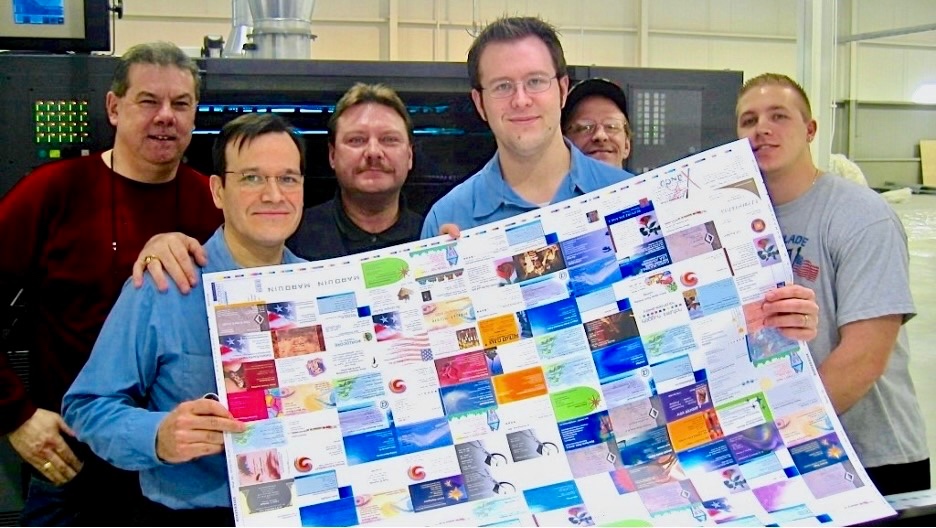
Jan and Josh kick-start their first job at the Windsor Plant in April 2005.
From L to R, Ciaran, Mike, James and Dean.
As the lead press operator and press instructor at VistaPrint, I was impressed by the efficient use of total equipment capacity in each production run and the high volume of orders processed daily using the layout imposition software.
CIMPRESS dominates the printing industry by implementing innovative manufacturing techniques, optimizing its manufacturing process, and ensuring a seamless workflow to enhance production capacity.
1. Packaging production (carton layout, nesting and ganging layout)
2. Label printing (roll-fed ganging layout)
3. Commercial Printing.
The planning stage is essential, as it sets the foundation for each repetitive product. It also highlights the need for Automation to guide the manufacturing process toward achieving higher throughput with minimal waste.
However, only one imposition software considers all process stages of Packaging ganging and aims to deliver the most cost-effective strategy focusing on downstream finishing alignment.
Only one software solution provides all the tools and flexibility needed to ensure predictability, precise Planning, and accurate quotes and project costs in the industry.

InSoft Automation's IMP earned the prestigious InterTech Technology Award at Graph Expo in 2016. This award, sponsored by the Printing Industries of America, recognizes technologies expected to have a significant impact on the printing industry. Santosh Mulay accepted the award from Mr. Brad Thompson during a gala event held in Orlando, Florida.
InSoft is known for its cost-based layout planning, estimation, ganging, nesting, and imposition capabilities. Recent updates emphasize no-mix ganging.
InSoft Automation specializes in layout planning, imposition, ganging, and print estimation. Its latest development optimizes production efficiency across various printing sectors, such as packaging, labels, and large-format printing.
1- Automated Imposition and Ganging
InSoft automates from customer requests to print-ready layouts. Intelligent Planning selects sheet sizes, web widths, and folding according to job specifications. Its gang capabilities allow for the efficient combination of multiple jobs, maximizing equipment capabilities and material usage while significantly reducing waste.
2- Smart Layout Planning
InSoft considers various cost centers and suggests the most economical printing equipment and work style. This optimization strategy ensures cost-effective production for jobs of any size and finishing style without manual calculations and time-consuming tasks.
3- Features for the emerging workflow Automation trend.
The latest release introduces several enhancements: REST API
Integration: Facilitates seamless Automation and integration with third-party MIS
platforms.
ImpCmd CLI: A command-line tool enabling easy integration and parallel processing.
Optimized ganging algorithms that prioritize delivery schedules, improving performance.
Block Ganging: Groups jobs with the same trim size, simplifying cutting and boosting productivity.
Overrun Controls: Customizable settings to limit overruns, minimize waste and maximize cost efficiency.
4- Integration with Workflow Automation Tools
Imp integrates with Enfocus Switch, enabling full workflow automation. This integration automatically generates nested layouts for all pending jobs, streamlining the production process.
5- Print Estimation Capabilities.
InSoft Automation is a Print Estimation software that simplifies the complexities of estimating and allows users to generate accurate quotes quickly and efficiently. It supports various pricing scenarios and job specifications, enhancing productivity and customer satisfaction.
To enhance your layout planning, which increases productivity and reduces waste, schedule a demo and compare your plan with InSoft options. You might be surprised by how easily you can increase throughput without requiring overtime or additional equipment.
Jan Sierpe is an instructor for sheetfed presses, a print media specialist, and a G7 Expert with extensive experience across the Americas, Europe, and the Middle East. He specializes in security printing, packaging, labels, and commercial printing. Additionally, he writes articles for Inkish, which have been translated into Spanish and published in various magazines.
I want to express my heartfelt gratitude to Rene Campbell.
She is a true inspiration, and I sincerely appreciate her contributions to this project.
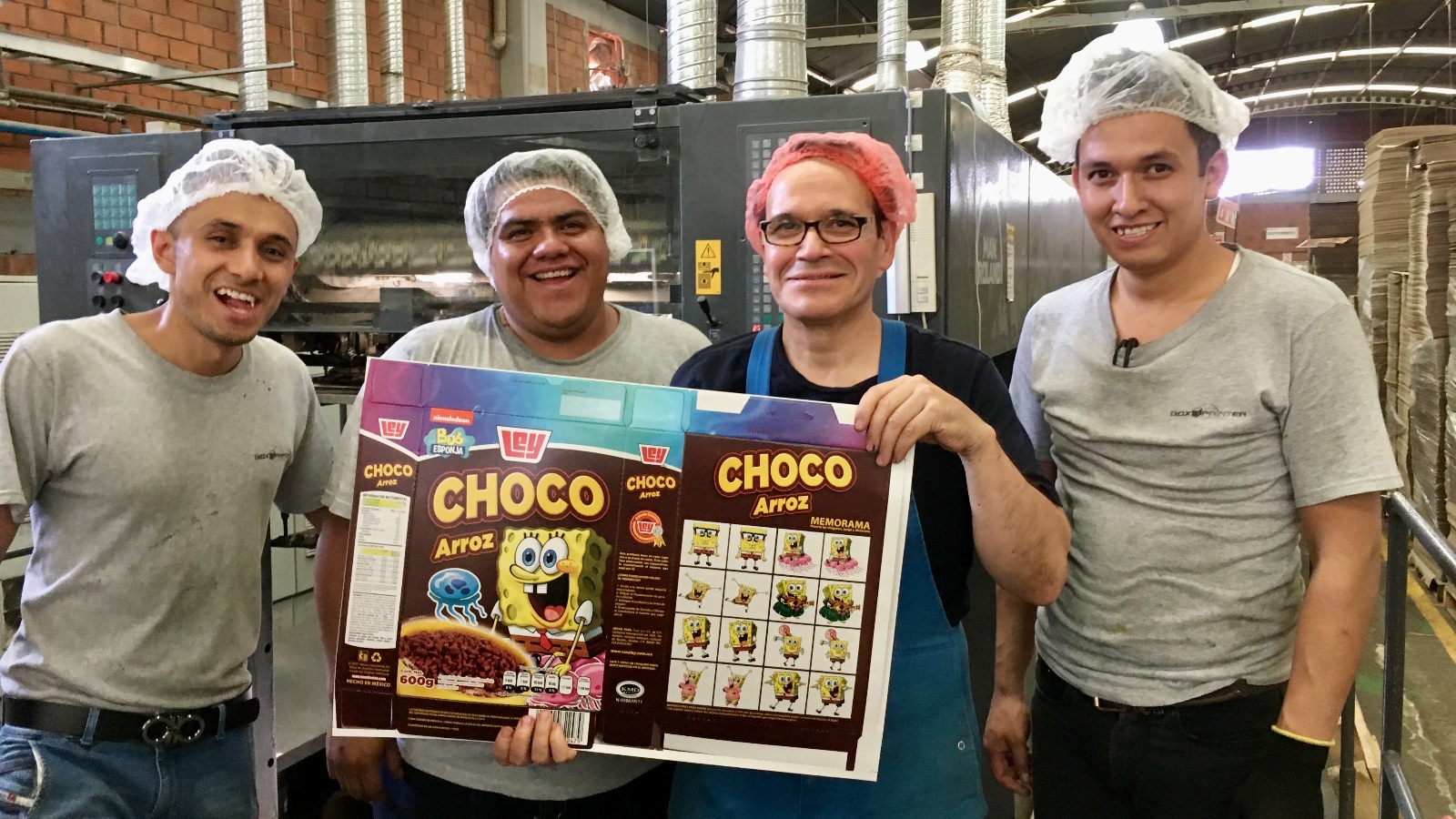
Box Printer. Leon, Guanajuato. Mexico. May 2017.

McCormick Place in Chicago with RIT Professor Frank Romano. Sep 2017.
Professor Frank Romano is the curator of the Museum of Printing at 15 Thornton Ave. Haverhill, MA.
I encourage everyone to visit and become a member.
Donate to the Museum to preserve the legacy of the Graphic Arts Industry.




Login
New User? Signup
Reset Password
Signup
Existing User? Login here
Login here
Reset Password
Please enter your registered email address. You will recieve a link to reset your password via email.
New User? Signup
Currency Exchange Graph