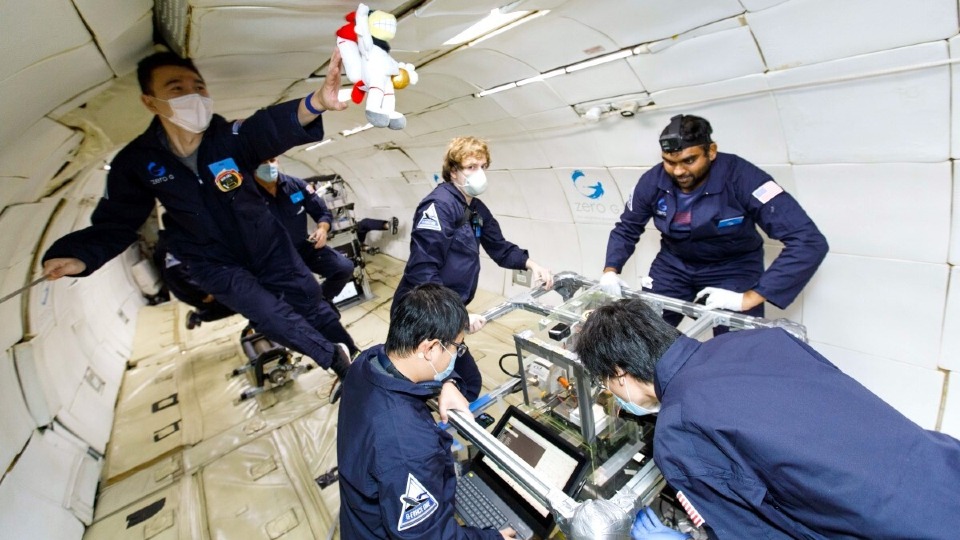
Ames, Iowa, USA – An Iowa State University engineer floats in the air (see photo) while other researchers hang tight to a metal frame surrounding and supporting their special printer. It’s not the usual photo you see in a research paper. Tests aboard microgravity flights aren’t your typical materials experiments, either.
The flight path to these experiments began when a research team led by Iowa State’s Shan Jiang, an associate professor of materials science and engineering, and Hantang Qin, formerly of Iowa State who’s now an assistant professor of industrial and systems engineering at the University of Wisconsin-Madison, wondered if their ink and printer technologies would work in the zero gravity of space.
The ink features silver nanoparticles synthesized with biobased polymers. After a heat treatment, the ink can conduct electricity and can therefore print electric circuits. The printer uses electrohydrodynamic printing, or 3D printing that jets ink under an electric field at resolutions of millionths of a meter. The electric field could eliminate the need for gravity to help deposit ink.
If the technologies work together in zero gravity, astronauts could use them to make electric circuits for spacecraft or equipment repairs. And astronauts might manufacture high-value electronic components in the special, zero-gravity environment of space.
NASA wondered if it would work, too.




Login
New User? Signup
Reset Password
Signup
Existing User? Login here
Login here
Reset Password
Please enter your registered email address. You will recieve a link to reset your password via email.
New User? Signup
Currency Exchange Graph