This article is a journey to the little-known world of Banknotes, iconic symbols and the technological transformation of ever-evolving security features, advantages, and the future against the strongly emerging cryptocurrencies trends.
Suppose you are an amateur collector or simply curious about the domain of banknotes, security documents, postal stamps, and credit cards. In that case, you might find this article interesting and informative. You might not look at a banknote again in the same fashion and possibly become an avid collector.
After reading this article, you might reconsider that crypto will replace world currencies. In my view, the natural notion of the value of real money through cash is irreplaceable. Security concerns deter investors as they understand that crypto can be a high risk to hacks. Trust seems to be the financial world's primary asset, and crypto is the weakest link.
Interestingly, most numismatic professionals and enthusiasts' collectors share a love for history and endless curiosity for details, while some focus on coins, others on collecting original pristine printed banknotes. And some of them add to their banknote collections postal stamps as they share similar technologies and craftsmanship.
We find those involved in minting coins and banknote printing processes within distinctive communities. And the deeper you explore this little-known domain of security printing, the more mesmerizing it becomes.
Around the world, one thing that is carefully guarded and protected with the highest security shield is currency printing and manufacturing—no matter where in the world, governments keep these highly secured factories off-limits. The reinforced walls of the immense vault are a few meters thick at the Bureau of Engraving and Printing (BEP) in Fort Worth, Texas., and could withstand several nuclear blasts. However, some of these locations host tours and visitors to peek at the process from a safe distance.What is most intriguing is that a handful of highly specialized professionals and talented artists are involved in the concept and creative process elements and designs using the most advanced and enduring protection against counterfeiting. These anti-counterfeiting techniques demand a combination of technologies and materials with intelligent strategies constantly and rigorously tested for effectiveness in every possible scenario.
Banknotes and security documents such as passports and credit cards have a life cycle. Security printing industry worth over 30 billion globally is a world of a sophisticated industry that assembles and connects the latest reproduction technologies with the most intricate techniques to produce outstanding results that surprise people as they quickly learn to embrace the new editions of banknotes.
Printing is only one step in a continuous production process that begins with an idea at highly secure and restricted locations. In the case of Euros, ECB assigns to any of the accredited twelve sites in Europe to print banknotes.
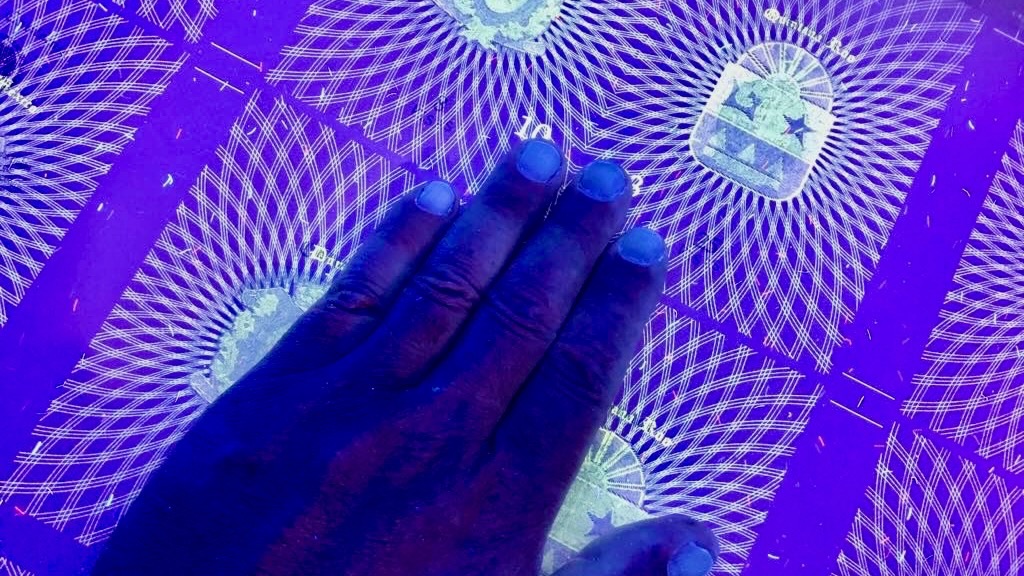
Photo of a passport inspection table at a security printing facility.
The security features used in most banknotes are tactile, visible, and invisible fluorescent printed elements—the tactile experience of the raised ink intricate details and denomination numbers printed with the intaglio process adds a particular lasting tactile feeling. In addition, the latest editions of banknotes have braille for the visually impaired.
Many technologies are exclusive to security printing. The holographic (Optically Variable Devices) and metallic images in transparent windows accurately registered the front against the backside are very noticeable and contain visible watermarks. Also, multicolour high-resolution micro-printed lines background patterns are the signature of Security currency printing.
These security features fulfill the three-level of security required for currency manufacturing. Also, include digital patterned watermarks and holograms and optically variable or metameric inks with diffraction grating properties that display colour changes when tilted. The security threads with microprinting, colour-shifting designs, 3-D visual appearance elements, and nano-optic and microlens features are some of the latest features used in currency.
Anti-counterfeit developments are constantly evolving as emerging technologies enable safer strategies to produce full-proof reproductions systems for banknotes and security documents. The Central Bank Counterfeit Deterrence Group (CBCDG) of 27 central banks and banknote printing authorities' mission is to investigate emerging threats to banknotes' security and propose solutions for implementation by issuing enterprises.
The Sverige's Riksbank is the Central Bank of Sweden. It is the oldest Central Bank in the world. But the first known banknotes developed in China during the Tang and Song Dynasties in the 7th century. However, the concept of money origins goes back to the beginning of time.
To most accounts, Europeans learn about paper banknotes currency from Marco Polo's narrative of his travels in China in the thirteenth century. He noted in his writings about the Chinese paper banknotes printed and their value and legitimacy in contrast with other forms of currency known and used in Europe.
To most, money and currency are the same. Banknotes and coins are not money but currency. The coins and bills we use and carry aren't technically money but are currency. Rare metals like silver and gold were considered money in the past, but today's money has become far more intangible.
Most paper currencies are Fiat money and give banks and Gov. more significant control over the economy because they can control how much money is printed and used.
Fiat money started when the high demand for metallic currency exceeded the supply of precious metals. It is a government-issued Currency that is not supported by a physical commodity such as gold or silver but rather by the government that issued it.
Most investors understand that fiat currency has a life cycle as it is subject to hyperinflation and drastic depreciation and loses buying power over time.
The Bureau of Engraving and Printing (BEP) has a boutique in the plant of Fort Worth, Texas, that I visited twice, where you can purchase any souvenirs associated with currency. From banknote trimmings to full uncut sheets of banknotes of all denominations.
Uncut sheets of 32 one-dollar bills spark curiosity and are a must-have among collectors. It is incredible to hold a printed banknote full sheet with a touch of extravagance, mainly when used as wrapping paper for unique gifts.
After Australia demonstrated the introduction of polymer currency with much success, many other countries slowly followed. Romania was the first European country to convert to polymer banknotes.
Polymer offers comparable if not superior possibilities for all counterfeiting security features reproduced in cotton substrates—security features such as microprinting, security thread, and portrait holograms. Also, U.V. printed images, photopolymer inks with metameric properties, and metallic shimmering changing colours.
Polymer banknotes' disadvantages are slipperiness and harder to count, fold, and sticky when wet. During the pandemic, many people believed that banknotes caused the rapid spread of the coronavirus in Italy and other European countries. But Germany's Robert Koch Institute recently confirmed that "virus transmission through banknotes has no particular significance."
This year, coincidentally commemorating sixty years of independence from Great Britain, Trinidad and Tobago's Central Bank entered the last phase to complete the transition to a new collection of colourful Polymer banknotes. Adopting this new generation of banknotes as they are durable, with solid security features, with more defined tactile features.
Among those security features are a see-through window, hidden printed invisible images only visible when exposed to U.V. light. The denominations $20, $50, and $100 include metalized shimmering visual effects.
A few weeks ago, after many delays due to the pandemic, Guyana introduced the first polymer banknote to commemorate the 55th independence anniversary. Printed in Canada, to many, the GUY $2,000 banknote design is far more representative of the multicultural heritage of Guyana and the promising bright and prosperous future of a young nation.
In Russia, since the trial of 2018, 100 rubles banknotes to commemorate the World Cup introduced a vertical design. The Russian Federation embarked on the most ambitious redesigning of banknotes and expected to launch soon an entirely new series of polymer banknotes far more secure and durable than existing currency.
The UAE Central Bank has issued the first polymer banknote on December 7 to commemorate the 50th anniversary of the birth of a nation, December 2.
The new Dh50 banknote has a portrait of Sheikh Zayed on the right and a commemorative picture of the founding fathers of the UAE. The reverse portrays Sheikh Zayed signing the Union agreement and a view of Etihad Museum.
Printed in a security printing facility in Abu Dhabi, Dh50 banknote is the largest circulation banknote in the UAE.
Because polymer notes last much longer the cash cycle, they will have a reduced impact on the environment than cotton-paper banknotes, and they are recycled. Visit a lifecycle analysis that compares polymer and cotton-paper notes.
The most recent banknotes designs reflect individuals who contributed to humanity, human rights, and the environment.
The latest addition to the polymer banknotes in Canada is the $10 dedicated to Viola Desmond. She is the first woman other than Queen Elizabeth II featured in a Canadian banknote. She was a thriving black businesswoman convicted and fined for refusing to leave a whites-only area of a movie theatre in 1946.
The $10 is packed with intricate designs and adopted the growing trend of vertical orientation rather than the traditional horizontal. This creative collaboration between the National Bank and the Canadian Bank Note Company (CBN), led by master engraver Jorge Peral, produced Canada's most elaborated banknote to date.
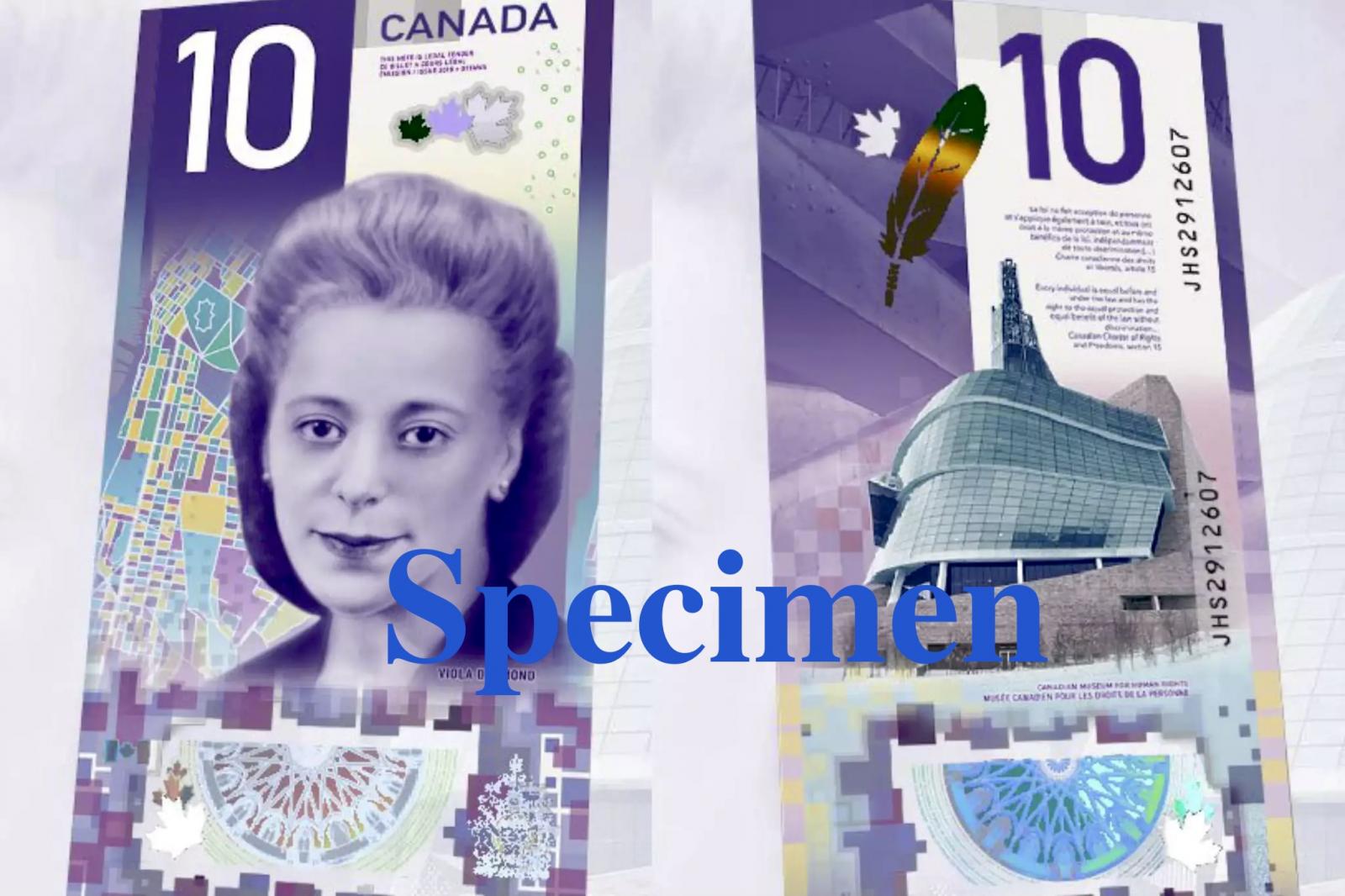
Viola Desmond's $10.
Canada remained with traditional banknote designs until the release of Viola Desmond's $10. After nearly twenty years of endless efforts of changing the look for Canadian banknotes was finally realized. I share the excitement of a departure from the traditional banknote horizontal design with a fresh vertical design with new patterns and fonts styles.
Canada was awarded again by the International Bank Note Society. The Bank Note of the Year Award for 2018, for the $10 Desmond banknote beating other outstanding designs from European countries, including Switzerland, with a vertical orientation design.
I am personally undecided as I have two favourites of the 2021 nominees. The new Mexican 50 pesos feature the iconic Mexican symbol based on the legend of the founding of the Aztec capital, Tenochtitlan.
The other favourite nominee is the Romanian colourful 20 lei banknote dedicated to Ecaterina Teodoroiu with a beautiful engraving. Check them out and pick your favourite banknote for 2021.
One upcoming event is worth watching in the forthcoming weeks. The Banknote and Currency Conference. High-Security Printing Latin America March 14-16, Mexico City.
Jan's first-hand field experiences expand several years in security, packaging and commercial printing with a particular focus on process optimization, waste reduction, and sheetfed press operator's training. This article intended to reach professionals directly involved in the printing process.
www.sierpe.ca





Login
New User? Signup
Reset Password
Signup
Existing User? Login here
Login here
Reset Password
Please enter your registered email address. You will recieve a link to reset your password via email.
New User? Signup
Currency Exchange Graph