
Inspired by Eddy Hagen's Analysis on The Evolution of Offset Printing, I decided to write my perspective on the evolution of offset printing.
While Eddy's detailed analysis of the evolution of offset printing provides valuable technical insights, it overlooks several critical dimensions that have shaped our industry's transformation. As someone who has lived through, implemented, and trained others on these technologies firsthand, I'd like to offer a more comprehensive perspective on how real innovation occurs in printing.
One of the most significant oversights in purely technical analyses is the transformational role of environmental awareness. Far from being mere constraints, ecological pressures have become powerful catalysts for breakthrough innovations that redefine our industry.
The shift to vegetable-based inks, the development of alcohol-free fountain solutions, and the elimination of film-based platemaking weren't just incremental improvements—they were a fundamental restructuring of how we approached printing chemistry and processes. Each change required extensive research, development, and real-world testing that pushed the boundaries of what was technically possible.
Perhaps most challenging was the development of recycling systems for UV-printed materials. Having witnessed the intensive research presented at TAGA meetings, I observed scientists working through complex polymer chemistry problems in real time. The trial-and-error process was exhaustive, requiring innovation in both de-inking chemistry and UV ink formulations. This wasn't just about making inks more environmentally friendly—it fundamentally changed how we think about the entire lifecycle of printed materials.
Not all technological advances carry equal transformational weight. Some technologies address universal pain points that affect the entire industry, while others cater to specific market segments.
CTP (Computer-to-Plate) and FM screening were genuinely transformational. I remember the overnight RIP sessions required for complex multicolour work, the rooms needed for file storage, and the rigid silos between prepress and press operations. These technologies didn't just make things faster—they fundamentally changed how the industry operated.
FM screening, for instance, emerged primarily as a solution to data management challenges. The quality improvements were almost secondary to the practical need to handle increasingly complex files without overwhelming computing resources. It solved a universal bottleneck that every operation faced.
In contrast, technologies like Landa's nanography serve specific market niches. It isn't a weakness—it's appropriate technology targeting where it makes economic sense. The industry benefits from both transformational technologies that change everything and specialized solutions that cater to specific needs.
There's a world of difference between observing a technology demonstration and implementing it in a real production environment. Trade show demos, while impressive, operate under controlled conditions that rarely reflect the complex variables of actual production.
Dan Gelbart's vision of having plate setters next to printing presses exemplifies this gap. Conceptually brilliant and technically feasible, this integrated approach challenged decades of established departmental boundaries and job classifications. While it worked at operations like Vistaprint—essentially a digital-native company that could implement integrated workflows from scratch—traditional printers found the organizational changes more challenging than the technical implementation.
The success of Dan's vision at Vistaprint highlights how technology reception fundamentally depends on Company DNA. Vistaprint, born as a digital-native operation, had integrated workflows embedded in its organizational culture from inception. They didn't need to overcome decades of departmental silos or traditional job classifications.
This alignment went beyond just organizational culture. When Vistaprint set up its operations, it specifically chose Manroland because the press design was fundamentally based on automation and lean manufacturing principles.
Unlike other manufacturers who adapted and retrofitted automation onto existing traditional designs—a convoluted approach that often created complexity rather than eliminating it—Manroland understood automation and inline processes as tools for waste reduction, integrated into the fundamental architecture. Their press design philosophy naturally supported the kind of integrated workflows that made Dan's platesetter-next-to-press concept feasible.
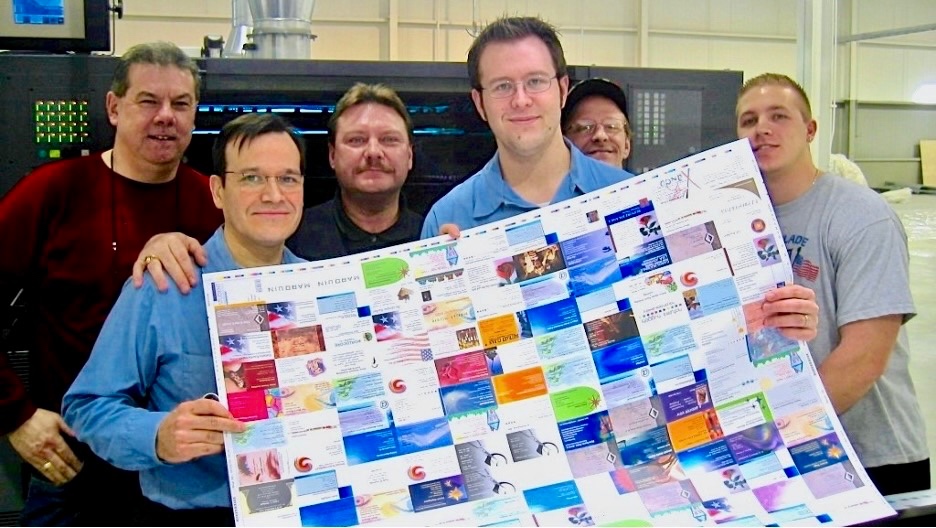
2005 - First printed sheet at Vistaprint's Windsor Plant in Ontario.
It reflects how successful technology adoption requires alignment at multiple levels—organizational DNA, equipment architecture, and operational philosophy all working in harmony. Companies that embrace lean principles and continuous improvement create fertile ground for innovations that may struggle in traditional organizational structures, which focus on departmental optimization rather than holistic workflow integration.
This highlights how successful technology adoption depends not just on technical merit, but on organizational readiness, workflow integration, and human factors that pure technical analyses often overlook.
Understanding where technologies fit in the market ecosystem requires both technical knowledge and practical experience. Benny Landa's innovations, from Indigo to nanography, have consistently targeted specific segments rather than attempting wholesale market displacement.
Nanography serves short- to medium-run applications where digital quality on offset substrates makes economic sense. Rather than competing head-to-head with high-volume B1 offset across all applications, it addresses jobs where traditional offset setup economics are not practical. This focused approach is actually a strength, not a limitation.
The industry benefits from this diversity of solutions. Not every technology needs to be universally transformational to be valuable and successful.
Having implemented these technologies, trained operators, and witnessed the research and development process firsthand provides insights that retrospective analyses cannot capture. We understand not only what solutions eventually worked, but also why specific approaches failed, how long iteration cycles actually took, and what trade-offs the industry faced during transition periods.
The printing industry's evolution wasn't just about achieving higher speeds, shorter makeready times, or better quality—though those improvements were significant. It was about solving real operational challenges while adapting to environmental constraints, changing market demands, and evolving customer expectations.
Technologies succeed not just on technical merit, but on their ability to solve genuine problems in real-world production environments. The most successful innovations often address multiple challenges simultaneously—improving productivity while reducing environmental impact, enhancing quality while simplifying operations.
Technical analyses provide valuable data points, but they tell only part of the story. The human elements—implementation challenges, organizational adaptation, market context, and the iterative process of real-world problem-solving—are equally essential in understanding how our industry evolved.
As we evaluate new technologies, we need both technical rigour and practical wisdom. The printing industry's future depends on innovations that not only perform well in controlled conditions but also solve real problems for real operations in real production environments. The story of printing's evolution is ultimately a human story—one of practitioners working to solve practical challenges while pushing the boundaries of what's technically possible.
About the author: Jan Sierpe is a global press instructor and print media specialist with over 35 years of experience in the Americas, Europe, and the Middle East.
As a contributing writer for Inkish in Denmark, Jan analyzes trends in the printing industry. His technical insights are published in multiple languages in various international trade publications. He specializes in continuous improvement, process optimization, and waste reduction in multiple areas, including security printing, packaging, labels, newspapers, large-format inkjet printing, and commercial printing.
Jan Sierpe | 416 697 8814 | sierpe.jan@gmail.com
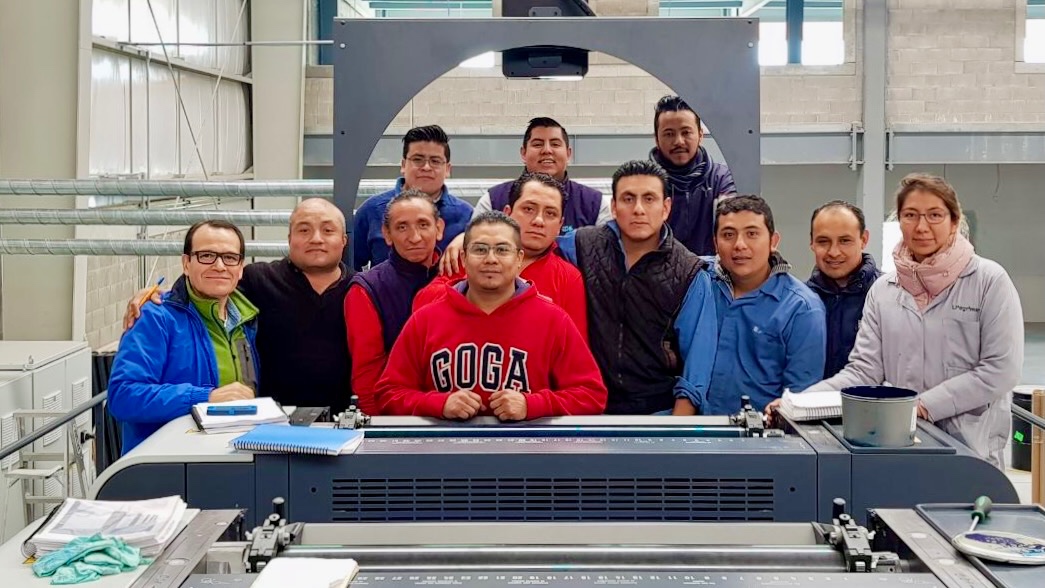
Litogrimann, 2018. Toluca. Mexico

Proofed (Human)

Listen to This Article

Loading...

Login
New User? Signup
Reset Password
Signup
Existing User? Login here
Login here
Reset Password
Please enter your registered email address. You will recieve a link to reset your password via email.
New User? Signup
Currency Exchange Graph