By Editor-in-Chief Morten B. Reitoft
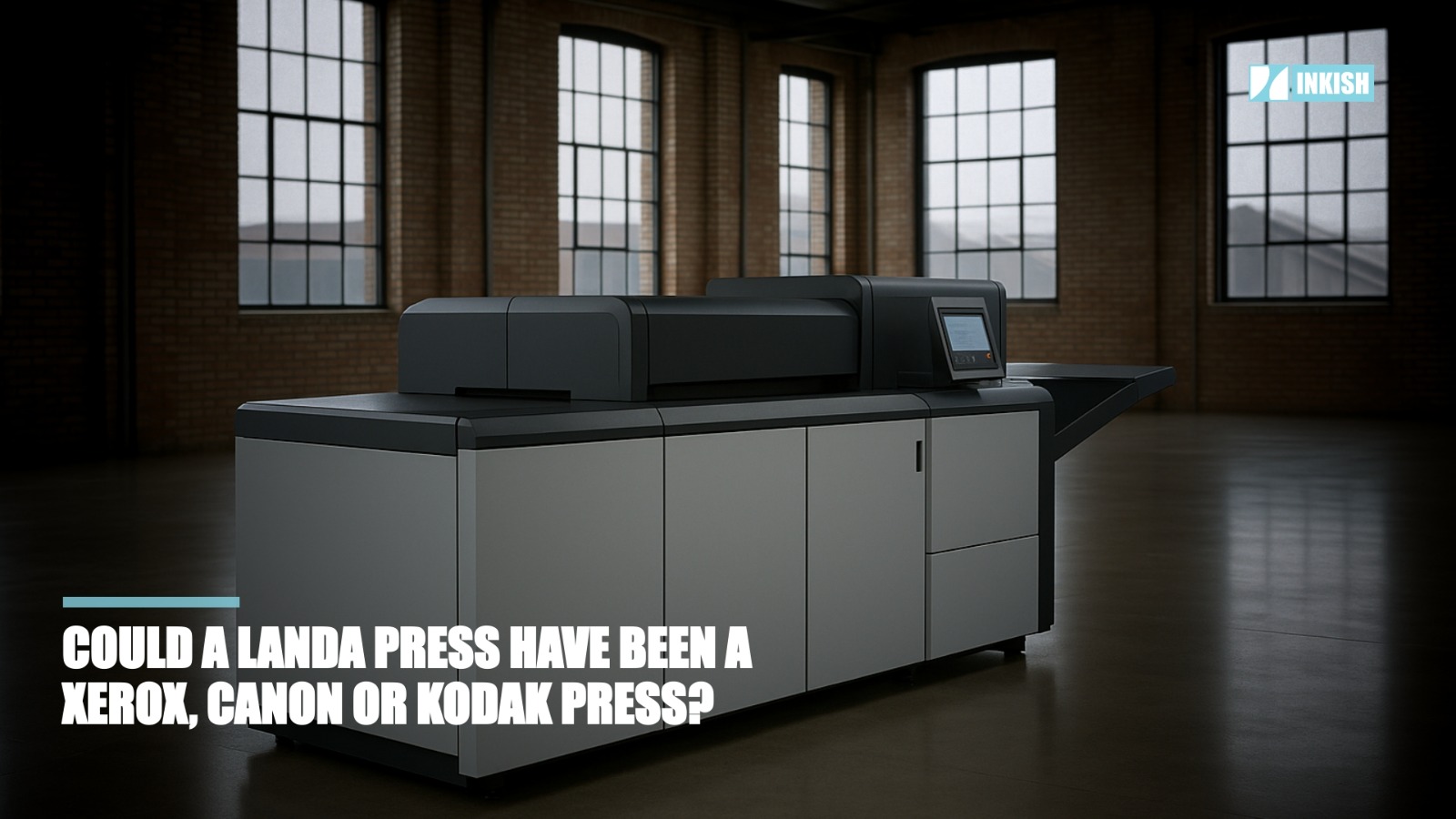
Three years ago, INKISH visited HP in Israel. During the visit, I spoke with Golan Landsberg, who has led the Indigo development for HP for a long time. He then said that HP's toner technology could beat inkjet in speed. The reason I'm asking is that, according to Israeli media, HP may be interested in acquiring Landa Digital Print. Naturally, one might wonder why they would be interested in this, given that they already possess technology that surpasses Landa in speed. I was also interested in understanding whether HP, with its Indigo patents, in reality needs Landa to do so. The short answer is that Indigo and Landa have many similarities and many differences.
As I read about the patent differences, I soon realized that Benny Landa wasn’t the only one considering these aspects. The year after the Nanography patent was applied for (2012), Xerox also applied for a patent called WEC (Wetting Enhancement Coating)(2013), where Xerox printed indirectly on a film that would then be transferred to the substrate. The inventors Suxia Yang & Nan Xing, whose names are on the patent, developed a technology that was never commercialized but worked as follows. Rather than printing on a heated blanket, like with Nanography, WEC printed on a thin film, which was then transferred to the substrate. This approach added a thin lamination film to the substrate, rather than using polymers in ink, to create a similar thin film.
Xerox never commercialized WEC.
Back in 2008, Canon/Océ already filed for a patent named Inkjet-to-belt then transfer. Océ was the inventor of the technology, as OCÉ was only acquired by Canon in 2010. When reading about this patent, it seems to be the one that most closely resembles Nanography. In the patent, the process is described as follows: Add a release/conditioning layer to a drum or a rotating belt. Ink onto the layer, partially dry the print, and transfer the image to the substrate using heat and pressure. Canon never brought the technology to market and delivers today direct-to-media inkjet technology using printheads from Kyocera and Canon.
Océ even looked at an indirect technology back in 2005 when they announced ‘Océ’s Direct Imaging 7 Color Technology.’ The design was quite different, as it didn’t have a photoconductor, but a drum with several conducting zones that transferred the finished image to a rubber belt, which delivered the image to paper.
According to the technical documents found on imaging.com, the technology was both unique and offered high quality with great registration. However, I spoke to a source within Canon who mentioned that there were issues with the rubber band. The technology was, as far as I can read, only used in the OCÉ CPS900, and just to be clear - not inkjet, but toner.
But the story and interest in indirect inkjet printing don’t stop here. Back in 2001, NexPress Solutions LLC was granted patent US 6,761,446 B2. Let the patent description stand for itself: “Uses an inkjet device to form an image on an intermediate member, removes excess liquid, then transfers the liquid-depleted image to the receiver by electrostatic/thermal/pressure nip.” - The patent was transferred to Kodak in 2004. NexPress Solutions LLC was the 50/50 Joint Venture between Heidelberger Druckmaschinen and Kodak.
Had the patent been made into a product, and had Heidelberg, for example, owned it, the world could have been different today. None of the above patents, except those granted to Landa, have been developed into commercially available products. A search for companies exploring an offset digital future reveals many more companies that have filed patents. To mention a few, Ricoh, Hitachi, Seiko/Epson, Riso, Konica-Minolta, and probably more.
Why is this of interest?
I can’t say that indirect inkjet printing in itself should be of interest. Still, this story proves that many suppliers have had many different considerations about how to achieve high-speed inkjet printing. High-speed digital printing, regardless of technology, is by all means the next step in the evolution of print. I know many printing companies today utilize digital print and produce fantastic applications, to the satisfaction of the customers, and are also profitable. I am, however, still convinced that most owners of toner-based printers use these for small-run printing, and less for variable data, personalization, and other features that will make your printing more valuable in the future. Offset printing will continue to be a crucial technology in the future. I do, however, wish that the Litho OEMs would consider making smaller, cheaper machines more aligned with a market that is out-competed by the offset manufacturers themselves - the majority of smaller printing companies that need good, reliable technology, in smaller formats. The focus doesn’t seem aligned with the market, in my opinion.
I found researching this article really interesting, and I learned some new things - maybe you did too?

Proofed (Human)

Listen to This Article

Loading...

Login
New User? Signup
Reset Password
Signup
Existing User? Login here
Login here
Reset Password
Please enter your registered email address. You will recieve a link to reset your password via email.
New User? Signup
Currency Exchange Graph